Does Nature Art in a Home Office Really Help You Focus?
Last Updated: October 24, 2026
Quick Summary
Nature art supports focus indirectly by softening a room, giving your eyes a calm resting point, and reducing visual fatigue, so treat calm as the goal and focus as the likely side effect. Choose a single framed botanical or landscape print sized to roughly 50% to 75% of your desk width and hung at seated eye level.
- Natural scenery gives the eye a low-effort resting point, which helps reduce stress.
- Size art above a desk at roughly 50% to 75% of the desk's width.
- Hang the art's center at or just above seated eye level, keeping a gap above the monitor.
- Use matte paper and non-reflective glazing to prevent glare in your line of sight.
- Renters should use adhesive strips rated above the frame's weight and choose lighter canvas prints.
Table of Contents
- Why Nature Art Belongs in a Home Office
- Home Office Wall Art Ideas That Do More Than Decorate
- How to Arrange Art Above a Desk Without Getting the Scale Wrong
- Gallery Wall Ideas for Home Office Walls That Stay Calm
- Matching Nature Art to Your Work Tasks and Personality
- Renters, Small Rooms, and Video-Call Backgrounds
- Choosing Your First Piece for the Office Wall
- Frequently Asked Questions
Why Nature Art Belongs in a Home Office
Nature art is artwork that borrows its subject, color, or feeling from the outdoors: landscapes, botanical prints, trees, flowers, and organic forms.
The pull toward greenery indoors is real. Biophilic design, the practice of working natural elements into a room, has moved from architecture firms into ordinary home offices. U.S. General Services Administration research on workplace design has looked at how light, views, and natural materials shape how people feel at work.
Here is what most guides get wrong: they promise that a landscape print will fix your concentration. It won't. What nature art reliably does is soften a room, give your eyes somewhere calm to land, and make a space feel less like a cubicle.
That is worth a lot on its own.
- Stress reduction: natural scenery gives the eye a low-effort resting point
- Mood: green tones and organic forms read as calm, not urgent
- Visual interest: a bare wall above a monitor is tiring to look at all day
Treat calm as the goal and focus as the likely side effect. That framing keeps your expectations honest.
Home Office Wall Art Ideas That Do More Than Decorate
Start with what hangs above the desk. A single framed botanical print, centered over the monitor, does more for a workspace than a busy cluster of small pieces.
Here are starting points that work in most rooms:
- A lone landscape print in a simple frame, sized to the desk below it
- A pair of botanical studies in matching frames, hung side by side
- A pressed-flower or leaf print for a softer, more personal feel
- An abstract piece with green and earth tones when you want calm without a literal scene
- A small art set that carries one idea across several panels
The common mistake is buying art that matches the sofa instead of the work. Your office wall is not a living room wall.
Natural textures help too. Linen mats, wood frames, and matte paper keep a print from glaring under a lamp.
How to Arrange Art Above a Desk Without Getting the Scale Wrong
The right size for art above a desk is roughly 50% to 75% of the desk's width, hung so the center of the piece sits at or just above eye level when you are seated. Too small and it looks lost. Too large and it crowds you. That ratio is the starting point, not the whole job, viewing distance, lighting, and glare decide whether the piece actually works once it is on the wall.
Start with the numbers
Measure before you buy. A quick method:
- Measure your desk width and note the number
- Measure from the desk surface to your seated eye level (sit in your chair, look straight ahead, and mark the wall)
- Choose a piece 50-75% of the desk width
A common pattern is to treat the art's center as the anchor: place it at or slightly above seated eye level so you are not tilting your head up or down to take it in. If your monitor is tall or mounted on an arm, raise the art so the bottom edge stays a few inches above the screen, a clear gap keeps the desk from feeling compressed.
Viewing distance and piece size
Viewing distance matters as much as width. From a seated position, a piece reads comfortably when its longest dimension is roughly one-quarter to one-third of the distance from your eyes to the wall. In practice, that means a print hung 3 to 4 feet in front of you can be smaller than one hung across a wide room, and a large anchor piece belongs on the wall you face from farther back, not directly over a monitor you sit inches from.
Use these rules of thumb:
- Directly above the monitor: keep the piece modest, roughly 50% of desk width, so it does not dominate your field of view
- On the wall you face from across the room: a larger piece at 75% of desk width or more can anchor the space
- On a side wall: size to the wall segment, not the desk, and keep the center at seated eye level
Lighting and glare
Glare is the most common reason a good print looks bad in a home office. Glass-framed art opposite a window will reflect the window and wash out the image for much of the day. Options:
- Use matte paper and non-reflective glazing (anti-glare glass or acrylic) for pieces in your line of sight
- Angle a desk lamp so light grazes the art rather than hitting it head-on
- Avoid hanging glossy prints directly opposite a window or a bright monitor
Natural textures help too. Linen mats, wood frames, and matte paper keep a print from glaring under a lamp.
If you want a deeper walkthrough on scale and placement, our guide on how to arrange statement art above a desk covers the measurements in detail.
Gallery Wall Ideas for Home Office Walls That Stay Calm
A gallery wall in an office should feel quieter than one in a hallway. Fewer pieces, more space between them, and a tight color palette keep it from turning into noise.
Three layouts work well behind a desk:
- A row of three equal prints, evenly spaced, for a clean horizontal line
- A grid of four or six smaller pieces, aligned to a strict edge
- One large anchor piece with two smaller prints beside it
Keep the gap between frames consistent, usually a few inches. Stick to two or three frame finishes at most. And keep the subject matter related: botanical art, landscape art, and natural textures belong together.
If you are weighing a mirrored layout against an off-center one, our guide to symmetrical vs asymmetrical gallery walls explains which suits a workspace. For tighter rooms, these modern gallery wall ideas for small spaces show how to fit a wall arrangement without overwhelming the desk.
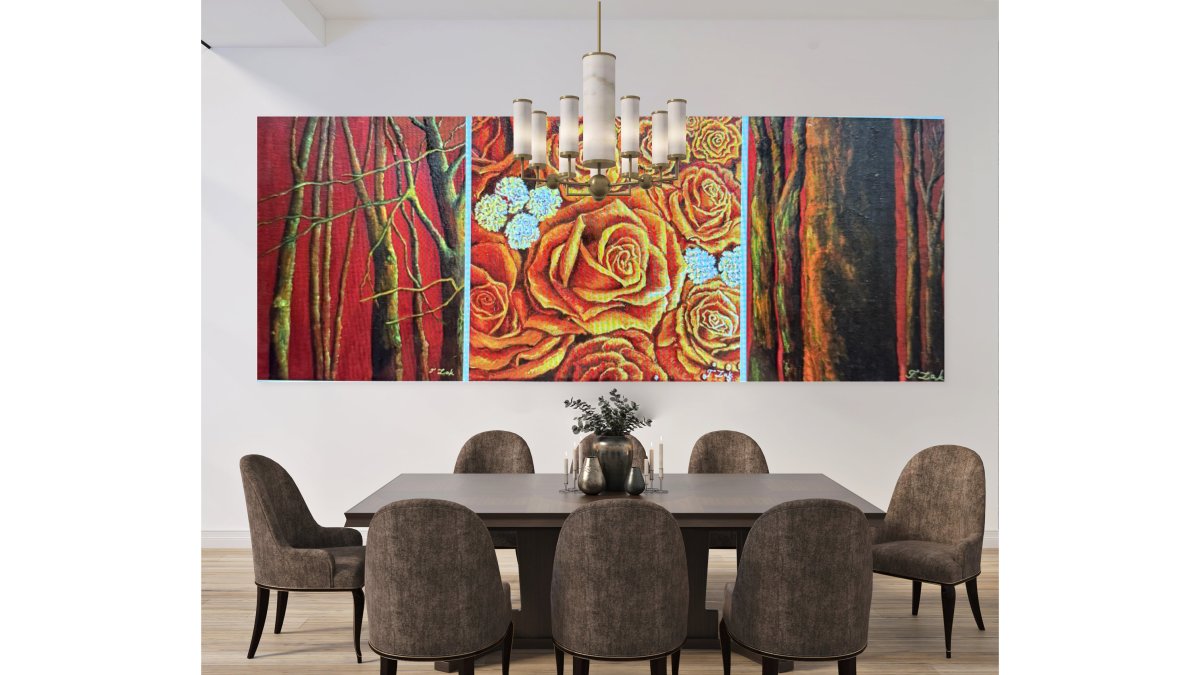
Set of 3 Canvases- Roses and Trees →
Matching Nature Art to Your Work Tasks and Personality
Match the art to the work. Deep focus tasks suit calm, low-contrast scenes: misty landscapes, single botanical studies, muted green tones.
Ask yourself three questions:
- What do I do most at this desk?
- Do I want the wall to settle me or wake me up?
- What natural scenery do I already return to?
Your answers point to a palette. Someone who writes for a living may want a quiet forest print.
Personality matters as much as task. If you love pressed flowers and flora, lean into botanical art.
For a deeper look at choosing pieces that carry personal meaning, our guide on how to choose meaningful wall art walks through the process.
Renters, Small Rooms, and Video-Call Backgrounds
Renters and small-room workers face the same problem: you cannot drill freely, and you cannot afford to get the scale wrong. The fix is lightweight, removable, and sized to the wall you actually have. This is the section most guides skip, the practical constraints that decide whether nature art makes it onto your wall at all.
Removable mounting that holds
Adhesive strips are the default for rental walls, but they only work when you match the strip rating to the frame's weight and follow the surface rules:
- Use strips rated above the frame's weight, and add an extra pair for glass-framed pieces
- Clean the wall with rubbing alcohol and let it dry fully before applying
- Avoid freshly painted walls, wallpaper, and textured surfaces, where strips often fail
Canvas prints are lighter than glass-framed art and are the safer choice for adhesive mounting. For heavier pieces, a picture ledge or a leaning arrangement avoids the wall entirely.
Budget-conscious options
You do not need a limited edition to get the effect. Affordable prints, open-edition posters, and DIY botanical art, pressed leaves and flowers in simple frames, deliver the same calm for a fraction of the cost. Removable hanging methods keep the deposit safe, and accessible placement (leaning, ledges, shelf-top arrangements) means you can change the wall without patching holes.
Small rooms
Small rooms reward vertical thinking. A tall, narrow print above a slim desk adds height without eating floor space. Keep the palette tight and the piece count low: one statement piece reads calmer than a cluster in a tight room. If the desk sits in a corner, size the art to the wall segment above it rather than the desk width, and keep the center at seated eye level so the piece does not crowd your sightline.
Video-call backgrounds
For video calls, the wall behind you is your backdrop. Keep it simple: one framed print, centered, with no glare from a window or lamp. A busy gallery wall behind a camera reads as clutter on screen. Position the camera so the art sits fully in frame with some breathing room around it, and check the shot at the start of a call, a piece that looks right in the room can crop awkwardly on screen.
For rental walls:
- Use adhesive strips rated for the frame's weight
- Choose canvas prints, which are lighter than glass-framed art
- Lean a larger piece on a shelf or ledge instead of hanging it
Choosing Your First Piece for the Office Wall
Buy one good piece before you buy five.
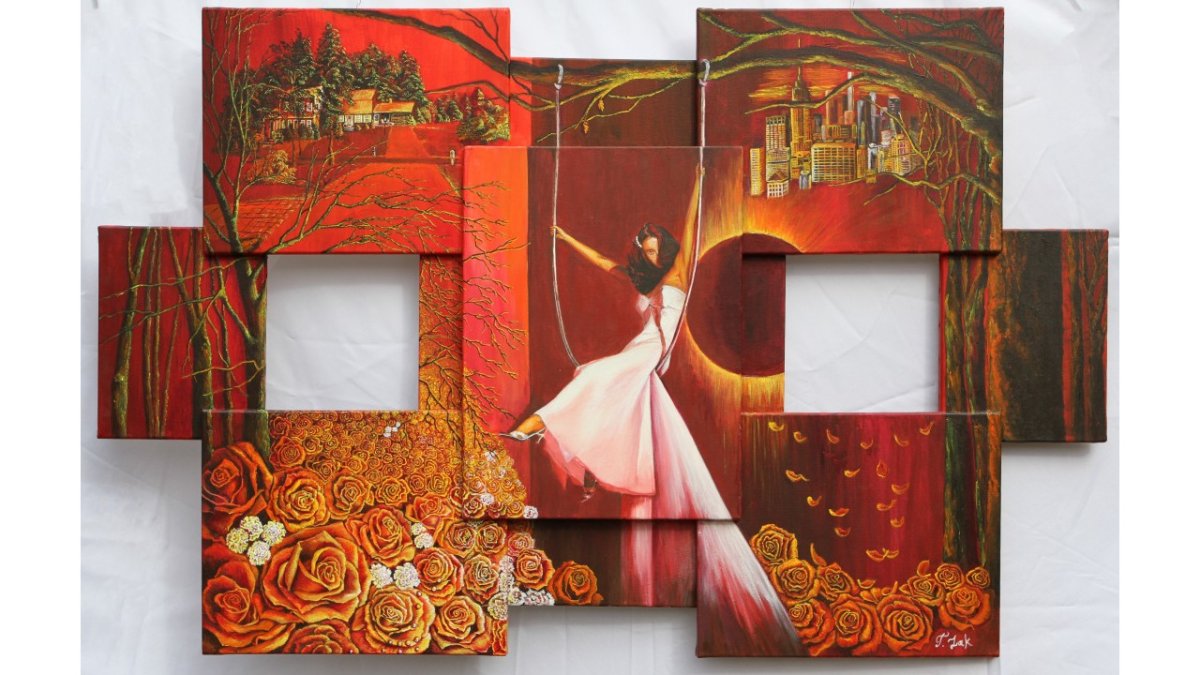
Our recommendation for a first office piece is the Swing of Life™ hand-embellished collector edition installation.

If a smaller start suits you better, the Set of 3 Canvases: Roses and Trees brings botanical and tree forms together in a set that reads as one calm idea.

And if you want a full wall of coordinated work, the Four-Panel Journey in Balance set offers four hand-enhanced 16" x 16" panels for $625.00.

For a focused buying walkthrough, see our guide to original art for a home office.
Setting up a home office that actually supports your work takes more than a desk and a chair.
Here are the first-piece options the article names, with their stated sizes and prices.
| Piece | Format | Size | Price |
|---|---|---|---|
| Swing of Life hand-embellished collector edition | Limited release of 35, signed and numbered | 42" x 66" | Ships free within the United States |
| Set of 3 Canvases: Roses and Trees | Set of three canvases | Not stated | Starts at $84.49 |
| Four-Panel Journey in Balance | Four hand-enhanced panels | 16" x 16" panels | $625.00 |
Frequently Asked Questions
Can nature-inspired art make a workspace feel calmer?
Many people report that nature scenes, botanical art, and green tones make a home office feel less sterile and easier to settle into. The effect comes from what you look at during short breaks between tasks, not from the artwork itself doing anything active. Choose a piece with soft natural textures and a color palette you find restful, and place it where your eyes land when you pause. Treat it as a cue to slow your breathing for a moment rather than a productivity tool.
How large should artwork be above a desk?
A common guideline is that framed art should span roughly half to three-quarters of the width of the desk or furniture below it. For a standard 48-inch desk, that means a piece around 24 to 36 inches wide, or a set of smaller prints grouped to that total width. Hang the center of the artwork at roughly eye level when seated, about 8 to 10 inches above the desk surface, so you can see it without craning your neck.
How do you arrange multiple art prints on an office wall?
Lay the prints on the floor first and move them around until the spacing looks even, usually 2 to 3 inches between frames. Keep the group's center at seated eye level and treat the whole cluster as one shape. A simple grid works well above a desk, while a looser arrangement suits a side wall. If you want a set that already shares a color palette and theme, a coordinated set of canvases removes most of the guesswork.
What should I avoid when hanging art behind a video-call desk?
Avoid glossy frames and glass that catch window light and create glare on camera, and skip busy patterns that compete with your face. Keep the wall behind you simple: one or two medium prints with generous space around them read better on a small webcam frame than a dense gallery wall. Also check that nothing reflective or brightly backlit sits directly behind your head, and angle your desk so a window is to the side rather than behind you.