10 Modern Gallery Wall Ideas for Small Spaces
Table of Contents
- 1. Minimalist Grid Layout for Tight Corners
- 2. Asymmetrical Salon-Style Arrangement on Narrow Walls
- 3. Vertical Stack: How to Arrange Pictures on a Wall When Space Is Limited
- 4. Modern Gallery Wall Layout With Matching Frames and Mixed Sizes
- 5. Floating Shelf Gallery: Small Wall Art Ideas With Rotating Displays
- 6. Gallery Wall Spacing: The Measurement Guide for Compact Rooms
- 7. Renter-Friendly Installation: Low-Damage Hanging for Gallery Walls
- Frequently Asked Questions
Last Updated: October 18, 2026
1. Minimalist Grid Layout for Tight Corners
Among 10 modern gallery wall ideas for small spaces, a minimalist grid layout works beautifully when wall space is constrained, using uniform frame sizes and spacing to create visual order without overwhelming a compact area. The key is precision: measure carefully and keep the grid tight, with 2-3 inches between frames maximum.
Grid layouts perform best on walls 4 feet wide or narrower. Choose 4-6 frames of identical dimensions (typically 8" × 10" or 11" × 14") in a 2×2 or 2×3 formation. This creates a strong focal point without demanding much square footage, and the uniformity makes the space feel intentional rather than cramped.
For a modern aesthetic, stick with matching black or white frames and vary only the artwork inside. Mix abstract prints with family photographs to add personality while keeping the frame presentation clean. This approach pairs exceptionally well with hand-embellished pieces like those from Tatyana Zak, where the artwork itself carries emotional depth and the frames simply present it without competing for attention.

2. Asymmetrical Salon-Style Arrangement on Narrow Walls
Salon-style gallery walls don't require massive wall real estate. The asymmetrical arrangement actually works better on narrow walls because it creates visual movement and prevents the space from feeling static.
Start by selecting 5-7 pieces of varying sizes and shapes, and lean them against the wall first to experiment before committing to nail holes. The goal is a balanced composition where pieces aren't perfectly centered but flow organically across the space. Mix portrait and landscape orientations, and vary frame colors subtly (matte black, natural wood, or brushed gold work together).
Narrow hallways and entryways are ideal: the asymmetrical layout draws the eye along the wall rather than stopping it dead center. A 3-foot-wide hallway can still display 6-8 pieces because the pieces don't need uniform spacing.
The beauty of salon-style is that it accommodates pieces of different depths and textures. Contemporary hand-enhanced prints from Tatyana Zak sit naturally alongside family photographs and smaller geometric prints because the asymmetry expects visual variety.

3. Vertical Stack: How to Arrange Pictures on a Wall When Space Is Limited
When horizontal space is the constraint, think vertically. A vertical stack maximizes wall height while using minimal width, perfect for narrow walls, tight corners, or spaces between furniture.
Stack 3-5 pieces in a single column, spacing them 3-4 inches apart. This works best when pieces are relatively uniform in width but vary slightly in height; the vertical line draws the eye upward and makes the room feel taller than it actually is.
This arrangement is particularly effective in small bedrooms, home offices, or hallway corners. A vertical stack of 5 pieces measuring 8" × 10" each requires only about 8 inches of horizontal wall space but creates significant visual impact, counteracting the feeling of cramped quarters.
Mix frame styles slightly for modern appeal, perhaps 3 pieces in matching black frames with 2 in natural wood. This breaks monotony without creating chaos. Combining personal photographs with contemporary prints maintains the personal connection that makes gallery walls meaningful.
4. Modern Gallery Wall Layout With Matching Frames and Mixed Sizes
This is the sweet spot for small spaces: matching frames with artwork that varies in size and subject matter. The consistent frames create visual cohesion while the mixed sizes and images keep the display from feeling too rigid.
Select one frame style, black metal works well in modern spaces, as do natural wood or brushed gold finishes. Then choose 6-8 pieces in a mix of sizes: perhaps three 11" × 14" pieces, three 8" × 10" pieces, and two 5" × 7" pieces. Arrange them so larger pieces anchor the composition while smaller ones fill gaps, creating a balanced but dynamic layout.
This approach lets you build the gallery wall gradually: start with three large pieces, then add smaller ones as you find artwork that speaks to you. It accommodates both personal photographs and contemporary art prints.
The mixed-size approach pairs beautifully with curated art collections. Tatyana Zak's hand-embellished limited-edition pieces work exceptionally well in this format because each artwork carries its own visual weight and presence. The matching frames ensure the collection reads as intentional rather than accidental.
| Frame Style | Best Wall Size | Number of Pieces | Ideal Room Type |
|---|---|---|---|
| Matching black metal | 3-4 feet wide | 6-8 pieces | Modern bedroom, office |
| Natural wood frames | 3-5 feet wide | 5-7 pieces | Minimalist living space |
| Mixed metallics | 4-6 feet wide | 7-10 pieces | Contemporary entryway |
5. Floating Shelf Gallery: Small Wall Art Ideas With Rotating Displays
Floating shelves are the most forgiving small-space gallery format because they let you change the display without new holes, but only if you size and mount them correctly. Treat the shelf as a mini gallery with its own rules, not a catch-all ledge.
Sizing the shelf to the wall. A single picture ledge 24-36 inches wide fits a wall run of 3-4 feet and holds 2-3 leaning frames in the 5" × 7" to 11" × 14" range.
Depth and lean. Standard picture ledges are 2-4 inches deep. A leaning frame needs roughly its own depth plus 1 inch of clearance, so a 1-inch-deep 11" × 14" frame sits comfortably on a 3-inch ledge, while a deep shadow-box frame may not. Lean frames back at a consistent 5-10 degree angle; mixed angles look like clutter.
Mounting mechanics. Ledges carry load differently than a single hook because the weight is distributed along the bracket. Anchor into studs wherever possible; where studs don't align, use toggle bolts rated for the shelf plus contents.
Rotating the display. Because nothing is nailed through the frame, you can swap a 16" × 20" statement print for a cluster of three 5" × 7" pieces in minutes. Keep a consistent frame family (all black metal or all natural wood) so rotation doesn't break cohesion, and vary only the artwork.
Trade-offs to know. Ledges hold less weight than hung frames, so heavy canvas or glass-fronted pieces belong on a hung layout. They also collect dust and can look busy on walls under 30 inches, where a single vertical stack reads cleaner. Use ledges where flexibility and low damage matter most, rentals, dorms, and growing collections.
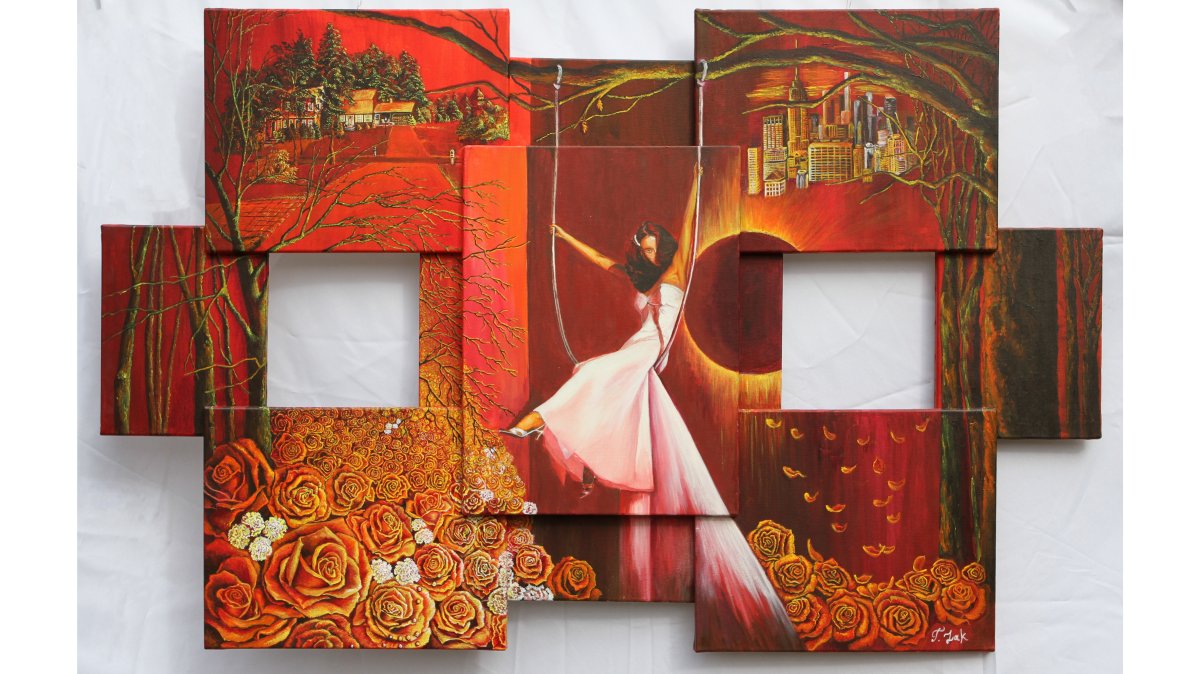
A Four-Panel Journey in Balance (16” X 16” each panel) Hand-Enhanced →
6. Gallery Wall Spacing: The Measurement Guide for Compact Rooms
Spacing is where small-space gallery walls succeed or fail, because viewers stand closer and every inconsistency shows. The standard is 2-3 inches between frames for a tight, modern look, and 3-4 inches when you want the arrangement to breathe.
Worked layout math. Say you have a 48-inch-wide wall and six 11" × 14" frames in a 2×3 grid. Three frames across at 11 inches each equals 33 inches of frame. Two gaps at 3 inches equals 6 inches. Total composition width: 39 inches.
Hanging height. The most common standard is to center the composition at 57 inches from the floor, roughly eye level and the same height museums use for a single work.
Clearance above furniture. Leave at least 6 inches between the lowest frame and the top of a sofa, bench, or console; below that, the art feels like it's sitting on the furniture.
The paper-template workflow. Cut paper templates to each frame's exact outer dimensions, tape them to the wall with painter's tape, and live with the arrangement for a day. Measure every gap with a tape measure, don't eyeball it.
Hanging sequence. Start with the center frame or the largest anchor piece and level it first. Work outward in pairs so symmetry stays true, checking level after every frame. In small rooms, a 1/8-inch tilt is visible from across the room, so re-check with a spirit level rather than trusting the frame's top edge.
Narrow-wall adjustment. On walls under 36 inches wide, reduce the gap to 2 inches and favor a single vertical column or a 2-wide grid. Wider gaps on a narrow wall make the composition look like it's dissolving into the corners.
7. Renter-Friendly Installation: Low-Damage Hanging for Gallery Walls
Renters don't have to choose between blank walls and lease violations. Several low-damage hanging methods work beautifully for gallery walls in small spaces.
Command strips and damage-free hooks hold surprisingly well for lightweight frames, an 8" × 10" frame weighs just a few ounces, so even basic strips work reliably. For heavier pieces like hand-embellished canvas prints, use heavy-duty strips rated for 5-10 pounds.
Adhesive picture hangers are another option: small metal hooks that stick with strong adhesive and leave minimal damage when removed carefully. They work best for frames under 5 pounds and hold securely for years.
For a completely damage-free option, use picture ledges or floating shelves. These mount to the wall studs (minimal holes) and let you lean frames rather than hang them. When you move, you simply remove the shelves and patch two small holes.
Whichever method you choose, test it on a small frame first. Peel off command strips slowly at a 45-degree angle to minimize wall damage.
Creating a modern gallery wall in a small space is entirely achievable, and these 10 modern gallery wall ideas for small spaces demonstrate that intentional planning and measured execution deliver results.
The most successful small-space gallery walls balance visual impact with restraint. You don't need dozens of pieces; 5-8 carefully chosen artworks create more presence than a cluttered arrangement.
Start with your wall dimensions and your available pieces. Then create a display that transforms your small space into a curated, intentional reflection of what matters to you. Interior design principles from the American Society of Interior Designers emphasize that even compact spaces deserve thoughtful curation.
Shop new arrivals at Tatyana Zak and find the pieces that speak to your space and your story.
Frequently Asked Questions
How do you create a gallery wall in a small space?
Start by measuring your wall and choosing a focal point, above a sofa, bed, or entryway works well. Plan your layout on paper first, using a grid or asymmetrical arrangement. Use uniform frames or consistent spacing to create cohesion. For small spaces, keep the overall display compact (2-4 feet wide) and position it at eye level. Hand-enhanced pieces like Tatyana Zak's Bride on the Swing (24" x 18") work beautifully as statement anchors in tight spaces because their emotional depth compensates for limited wall area.
What is the best layout for a small gallery wall?
Vertical stacks and tight grids work best in compact rooms. A vertical arrangement draws the eye upward, making ceilings feel higher. Asymmetrical salon-style layouts also work if you maintain consistent spacing (2-3 inches between frames). The key is visual balance: pair one large piece with several smaller ones, or use uniform frame sizes to create order. Avoid spreading pieces too far apart, this wastes precious wall real estate and breaks visual flow.
How far apart should pictures be on a gallery wall?
Standard spacing is 2-3 inches between frames. In small spaces, tighter spacing (2 inches) creates a cohesive, intentional look without overwhelming the wall. Measure the distance from the outer edge of one frame to the outer edge of the next. Use a level and measuring tape to mark positions before hanging. Consistent spacing makes even modest wall space feel curated and professional, which is especially important in compact rooms where every detail shows.
What size art works best in a small room?
Medium-sized pieces (16"-24" wide) anchor small gallery walls without dominating the space. A Four-Panel Journey in Balance ($625.00) works well because each 16" × 16" panel is substantial yet proportional to compact walls. Pair one medium anchor piece with 2-4 smaller prints (8"-12"). Avoid oversized art (30"+ wide) unless your wall is genuinely spacious. Hand-enhanced limited-edition pieces add visual weight and presence, so you need fewer pieces to create impact.