
How Do You Style Spiral Notebooks in a Home Office?
Last Updated: November 14, 2026
Quick Summary
To style spiral notebooks in a home office, choose a cover print that repeats a color from your room, then add small removable touches like a slim elastic band, a bookmark ribbon, or a labeled spine. Keep embellishments light so the notebook still flips and stacks easily.
- A compact 6" x 8" notebook fits beside a keyboard without crowding it.
- Number pages, build an index, and date every entry to stay organized.
- Stand one to three notebooks upright in a wooden or felt desk tray.
- Place the coil at the top or left edge if you write right-handed.
- Keep three objects on a desk so it reads as styled, not cluttered.
Table of Contents
- Why Spiral Notebooks Belong in Your Home Office Setup
- Choosing the Best Spiral Notebooks for Work
- How to Customize a Spiral Notebook to Match Your Space
- How to Organize a Notebook for Work Without Losing Track
- Spiral Notebook Storage Ideas for Desks, Shelves, and Small Spaces
- Practical Desk Arrangements That Keep Notebooks Accessible
- Pairing Notebooks With Art and Office Accessories
- Pick a Notebook That Makes You Want to Write
- Frequently Asked Questions
Why Spiral Notebooks Belong in Your Home Office Setup
Style spiral notebooks are bound paper notepads with a wire or metal coil binding along one edge, and they earn their place in a home office because they open flat and flip fully back.
The case for keeping one within arm's reach is simple. Screens capture what you type. Paper captures what you think.
- Ideas arrive mid-call and vanish before you open an app
- A quick note beats a locked phone every time
- A dated entry gives you a record you can flip back through
A spiral notebook also does something software cannot: it sits on the desk as an object. Choose one with a cover you love and your workspace starts to feel composed rather than cluttered.
Choosing the Best Spiral Notebooks for Work
The best spiral notebooks for work are the ones you actually reach for: a size that fits your desk, paper that suits your pen, and a binding that survives daily flipping. Get those three right and the rest is decoration.
Before you buy, compare paper, binding, and format side by side. Our guide to choosing notebooks for creative journaling walks through those trade-offs in detail.
Size, Paper, and Binding That Fit a Desk
Size decides where a notebook lives. A compact 6" x 8" notebook fits beside a keyboard without crowding it. A larger 5.5" x 8.5" format gives you more room per page for meeting notes and sketches.
Paper decides how writing feels. Ruled pages suit lists, planning, and daily entries.
Binding decides durability. Metal spiral and wire-o bindings are the binding styles offered on our notebooks.
- Ruled: lists, schedules, meeting notes
- Dotted: sketches, layouts, mood boards
- Compact: tight desks, bags, travel
How to Customize a Spiral Notebook to Match Your Space
Customizing style spiral notebooks is largely about the cover. Pick a print that echoes your wall art, your rug, or a color you already love.
Start with a cover that matches your palette. Then add small, removable touches so the notebook stays useful.
- Choose a cover print that repeats a color from your room
- Add a slim elastic band in a matching or contrasting tone
- Tuck a bookmark ribbon or paper clip at your current page
- Label the spine with a small sticker or washi tape
- Keep a single pen clipped to the coil for a finished look
Skip heavy embellishments. Glue, thick stickers, and bulky clips make a notebook hard to flip and harder to stack.
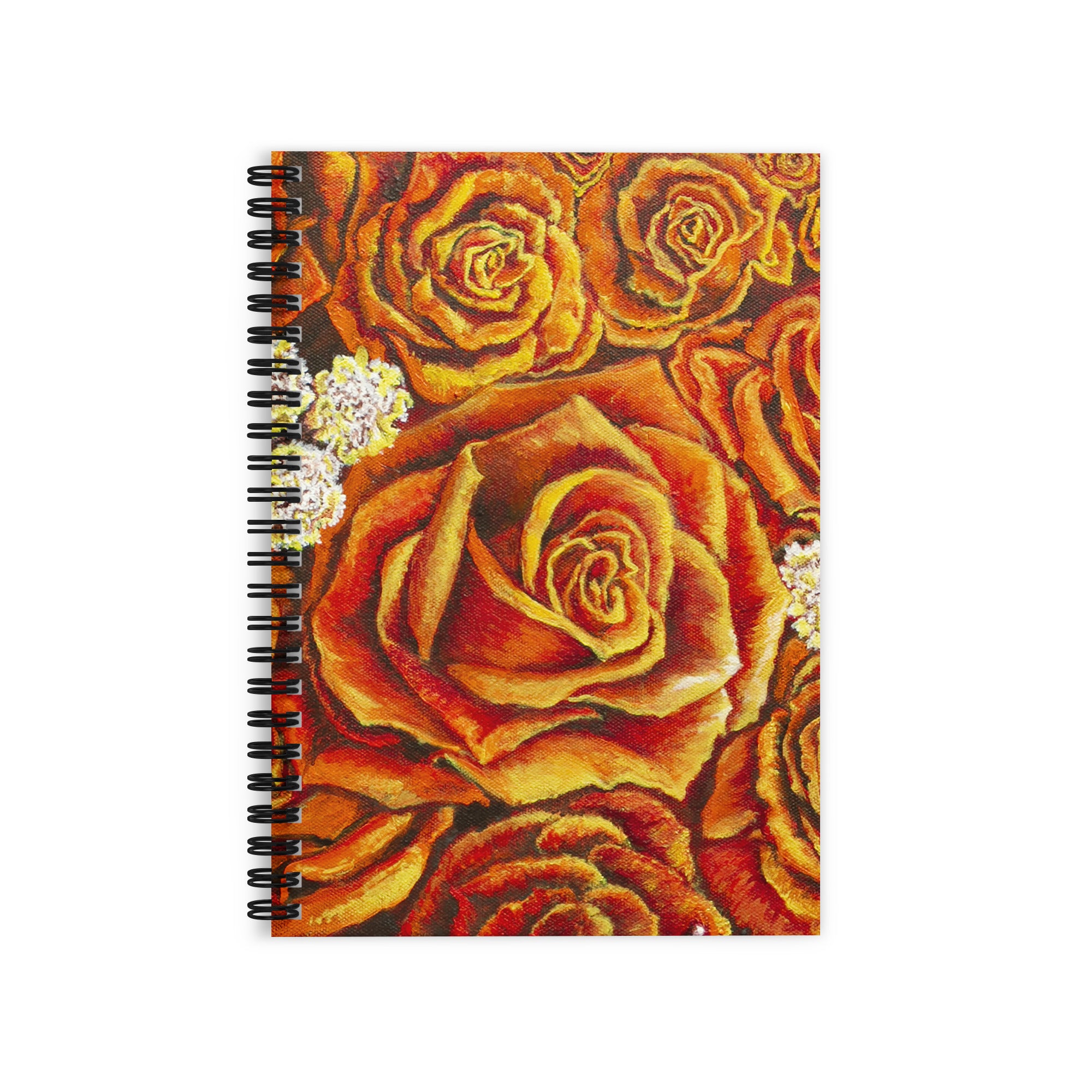
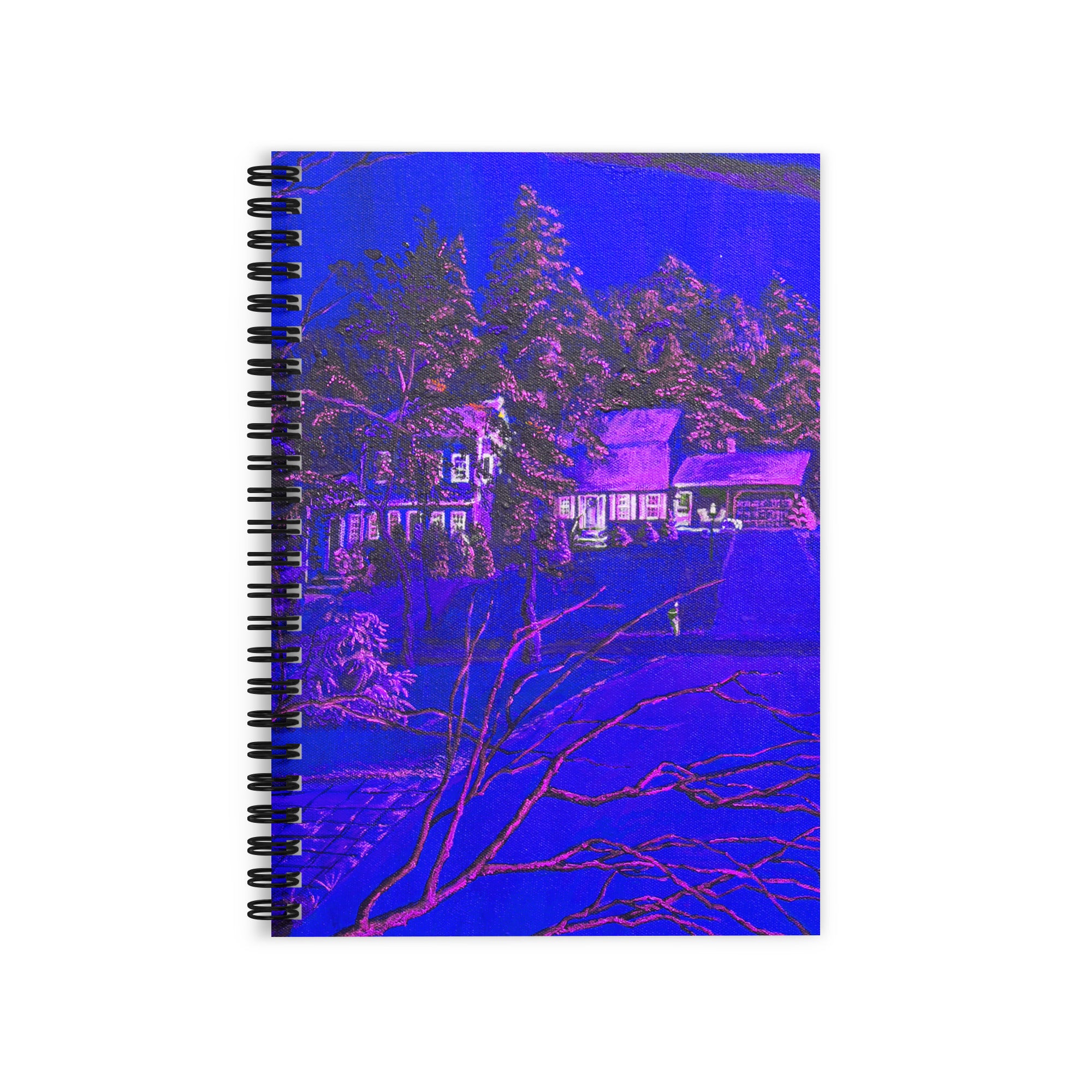
If you want a head start, our Roses & White Carnations ruled notebook and our Suburbs at Night ruled notebook both arrive with a front cover print, a dark grey back cover, and metal spiral binding, so the styling work is already half done.
How to Organize a Notebook for Work Without Losing Track
Organizing a notebook for work comes down to three habits: number the pages, build an index, and date every entry. Do those and you will never hunt for a note again.
Indexing, Numbering, and Daily Entries
Set up the notebook before you write anything important. Reserve the first two pages as a reference section and leave them blank until you have something to log.
- Number every page in the top corner as you use it
- Write the date at the top of each daily entry
- Log the page number and topic in your index as you go
A common mistake is indexing only big topics. Log small ones too, because small notes are the hardest to find later.
Spiral Notebook Storage Ideas for Desks, Shelves, and Small Spaces
Spiral notebook storage works best when you match the solution to two variables: how many notebooks you keep active and how large they are. A single 6" x 8" notebook needs almost nothing. A dozen notebooks in mixed sizes need a system, or the desk turns into a pile of coils and covers.
Start by sorting your collection into three groups: active (used this week), reference (used monthly), and archive (finished). Store each group differently, because they have different access needs.
Storage by quantity
- One to three notebooks: a single wooden or felt desk tray, or a small acrylic file sorter. Stand them upright so the covers face out and you can grab the right one without lifting a stack.
- Four to ten notebooks: a desktop magazine holder or a vertical file sorter with dividers. Group by size so the coils line up and the holder stays stable.
- Eleven or more: move the archive off the desk entirely. A bookshelf with bookends, a lidded storage bin under the desk, or a slim rolling cart beside the desk keeps the active set small.
Storage by size
- Compact 6" x 8" and smaller: shallow trays, pen-cup-adjacent caddies, and drawer dividers work well because the notebooks are short enough to stand without tipping.
- Larger 5.5" x 8.5" and above: deeper magazine holders, vertical file sorters, and shelf bookends. These formats need more depth, and a shallow tray will let them lean and bend the coil.
- Mixed sizes: store by height on the shelf, tallest at the ends, so the row reads as a clean line rather than a jagged edge.
Storage by desk layout
- Deep desk with wall space: a wall shelf above the monitor holds the archive and frees the entire work surface.
- Shallow desk or shared table: a slim rolling cart beside the desk, or a basket under the chair, keeps notebooks within reach without eating desk depth.
- No floor space: a hanging file pocket on the wall or the side of a bookcase holds five to ten notebooks flat and out of the way.
Small spaces call for vertical thinking. Our guide to displaying art in small offices covers the same vertical logic for framed pieces, and it applies to notebooks too.
Watch out: stacking more than four or five notebooks flat crushes the spiral coils and makes the bottom one hard to pull out. Stand them up instead, and keep the heaviest notebooks at the bottom of any stack you do build.
Match the storage solution to how many notebooks you keep active and how large they are.
| Notebook quantity | Storage solution | Note |
|---|---|---|
| One to three | Single wooden or felt desk tray, or small acrylic file sorter | Stand upright with covers facing out |
| Four to ten | Desktop magazine holder or vertical file sorter with dividers | Group by size so coils line up |
| Eleven or more | Bookshelf with bookends, lidded bin under desk, or slim rolling cart | Move the archive off the desk |
| Compact 6" x 8" and smaller | Shallow trays, pen-cup-adjacent caddies, drawer dividers | Short enough to stand without tipping |
| Larger 5.5" x 8.5" and above | Deeper magazine holders, vertical file sorters, shelf bookends | Need more depth to avoid bending the coil |
| Mixed sizes | Store by height on the shelf, tallest at the ends | Keeps the row a clean line |
Practical Desk Arrangements That Keep Notebooks Accessible
Accessible beats beautiful. The best desk layout puts your open notebook within arm's reach of where you sit, with your pen in the same zone, and keeps the binding oriented so your hand does not fight the coil.
A standard desk layout that works
On a typical 48" to 60" wide desk, divide the surface into three zones:
- Left zone (about 12" wide): notebook tray and the current work notebook, closed and standing upright.
- Center zone: keyboard and monitor, kept clear of paper so the notebook does not compete for typing space.
- Right zone (about 12" wide): pen cup, sticky notes, and a small lamp.
Rotate the active notebook weekly. Move the finished one to the shelf and pull the next forward. That single habit keeps the desk from turning into a pile.
Binding orientation and writing comfort
A spiral notebook opens flat, but the coil still takes up space. For a right-handed writer, place the notebook so the coil sits at the top or the left edge; for a left-handed writer, flip it so the coil is at the top or the right edge.
If you write near the binding, expect the last half-inch of the page to be awkward. Leave that margin for dates, page numbers, and symbols rather than sentences, and the coil stops being an obstacle.
Small-space and budget-friendly arrangements
- Compact desk: use a single tray on the left and a pen cup on the right, and keep only the active notebook on the surface. The archive lives on a wall shelf or in a basket under the chair.
- Shared or multi-use table: a slim rolling cart beside the table holds notebooks, pens, and a lamp, and rolls away when the table is needed for something else.
- Renter-friendly: use removable adhesive hooks for a hanging file pocket, and freestanding bookends instead of built-ins, so nothing damages the wall or the desk.
The goal is a desk that looks composed in a photo and still works on a busy Tuesday.
Pairing Notebooks With Art and Office Accessories
A notebook looks intentional when it sits beside objects that share its mood. Pair a floral cover with a ceramic vase or a soft textile.
Art does the heavy lifting here. Our nature art focus guide explains why a nature print in a home office supports concentration, which makes it a smart pairing for a work notebook you use daily.
Keep the accessory count low. Three objects on a desk read as styled. Eight read as clutter.
- One framed print, sized to the wall space
- One tray holding notebooks and pens
- One small plant or object with texture
The goal is a desk that looks composed in a photo and still works on a busy Tuesday.
Pick a Notebook That Makes You Want to Write
The best-styled notebook is the one you open every day.
Our spiral notebooks each have a front cover print, a dark grey back cover, and metal spiral binding, with 118 ruled line pages in a 6" x 8" size.
Pick a cover you love, give it a home on your desk, and let it hold the ideas that matter.
Your desk should make you want to sit down and think. That starts with a notebook you reach for and a wall that settles your attention.
Frequently Asked Questions
What are the best spiral notebooks for work?
Look for a ruled or dotted page count that matches how often you write, a metal spiral binding that survives daily flipping, and a size that fits your desk tray. A 6 x 8 inch ruled notebook with 118 pages suits meeting notes and lists, while a 5.5 x 8.5 inch dotted notebook with 140 pages works better for planning and sketching. Soft-touch covers resist fingerprints, and a dark back cover hides wear.
How do you organize a notebook for work so you can find notes later?
Number every page as you fill it, then keep an index on the first page with a short line for each entry. Reserve the last few pages as a reference section for recurring information like logins, project codes, or meeting dates. Start each day with a dated entry so you can scan the margin later. This takes about two minutes per notebook and saves far more time than flipping through loose pages.
How can you store several spiral notebooks on a desk without clutter?
Use a vertical file holder or a small wooden tray to keep three to five notebooks upright and within reach. Assign one notebook per project or topic so you are not stacking duplicates. For larger collections, a bookshelf with bookends keeps spines visible and dust-free, while a drawer organizer works for notebooks you use less often. Rotate the active notebook to the front of the tray each week.
How do you customize a spiral notebook so it looks professional in a home office?
Start with a cover that already matches your space, such as a printed art cover in muted tones, then add a simple label on the inside front page instead of stickers on the outside. Keep the spiral binding clear of washi tape, which catches on desk edges. A single ribbon marker and a matching pen clip do more for a polished look than heavy decoration. Choose one accent color and repeat it across your desk accessories.