How to Display Art in Homes: A Complete Guide
Table of Contents
- Understanding the Fundamentals of How to Display Art in Homes
- Gallery Wall Layout Ideas and Arrangement Patterns
- How to Hang Art at the Right Height
- Art Hanging Tools and Hardware for Secure Installation
- Mixing Media, Textures, and Creating Visual Depth
- Lighting Your Artwork and Creating Ambiance
- Room-by-Room Display Strategies and Curation
- Budget-Conscious Framing and Sourcing Strategies
- Frequently Asked Questions
Last Updated: September 27, 2026
Understanding the Fundamentals of How to Display Art in Homes
Displaying art in your home creates visual rhythm, establishes focal points, and transforms a room from functional to memorable. Understanding a few fundamental principles helps you start with confidence.

The difference between scattered and curated art comes down to three core principles: understanding eye level, grasping proportion and scale, and recognizing how negative space is just as important as the art itself.
The 57-Inch Rule and Eye-Level Placement
The 57-inch rule, measuring from the floor to the center of your artwork, is where the average person's eyes naturally rest. It's a useful anchor for how to display art in homes.
At eye level, viewers engage naturally without straining to look up or down. The piece becomes part of the room's conversation rather than an afterthought.
In high-ceilinged rooms, 57 inches might feel too low; in intimate spaces, drop to 55 inches. The key is consistency: align centers so the eye moves smoothly from piece to piece.
For statement pieces, a large canvas or installation like Tatyana Zak's hand-enhanced collector editions, consider what's behind the wall. A piece above a sofa should account for where people actually sit. Above a console table, the rule works almost perfectly. The principle holds: eye level creates comfort.

Scale, Proportion, and Visual Balance
A small 8x10 print on a 12-foot wall gets lost; an oversized canvas in a compact bedroom feels aggressive. Scale matters.
Your artwork should occupy 50-75% of the wall space above the furniture it anchors.
Gallery Wall Layout Ideas and Arrangement Patterns
A gallery wall is forgiving because it lets you mix, experiment, and evolve. Beauty lies in the overall composition, not individual elements.
Grid Layouts and Symmetrical Arrangements
Grid layouts are predictable and forgiving. A 2x3 grid is clean and balanced, even if pieces don't match perfectly. This approach works best with uniform frame sizes and styles.
Asymmetrical and Salon-Style Arrangements
Salon-style arrangements embrace imperfection with varied frame sizes, mixed orientations, and deliberate white space that create visual interest.
Spacing and Alignment Techniques
Spacing is where precision matters. The distance between frames affects how the eye moves across the wall. Too much space, and pieces feel isolated. Too little, and they compete for attention.
How to Hang Art at the Right Height
The 57-inch rule provides the foundation, but context determines whether a piece feels integrated or awkward.
Single Artwork Placement
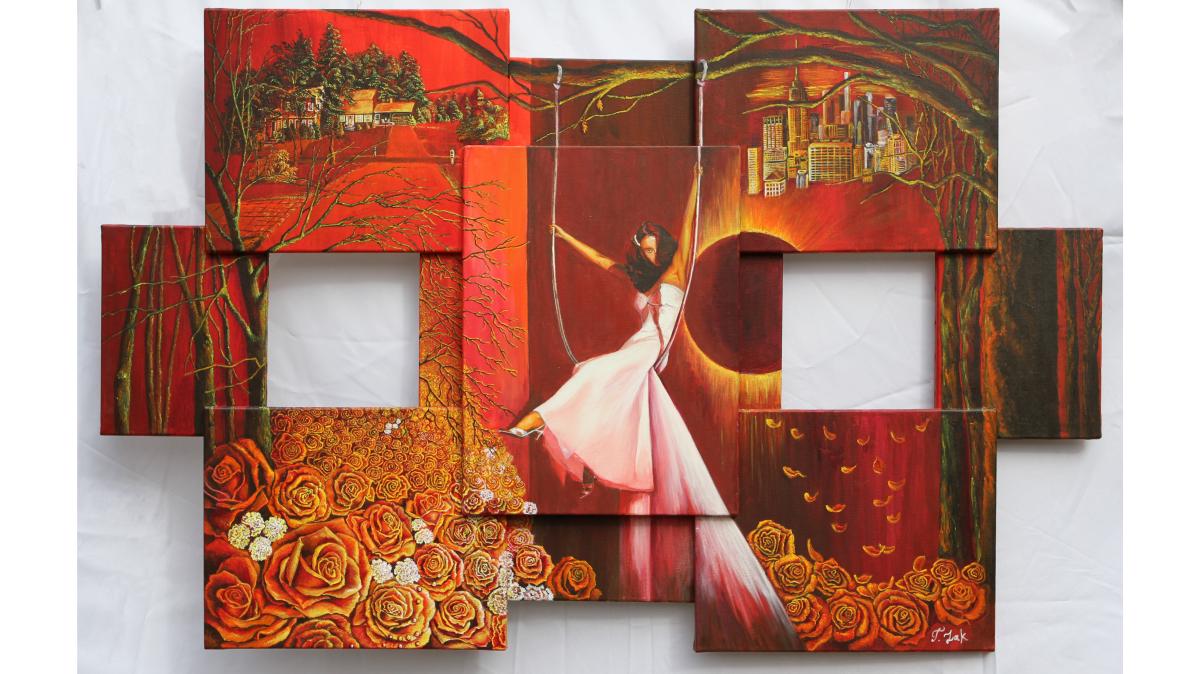
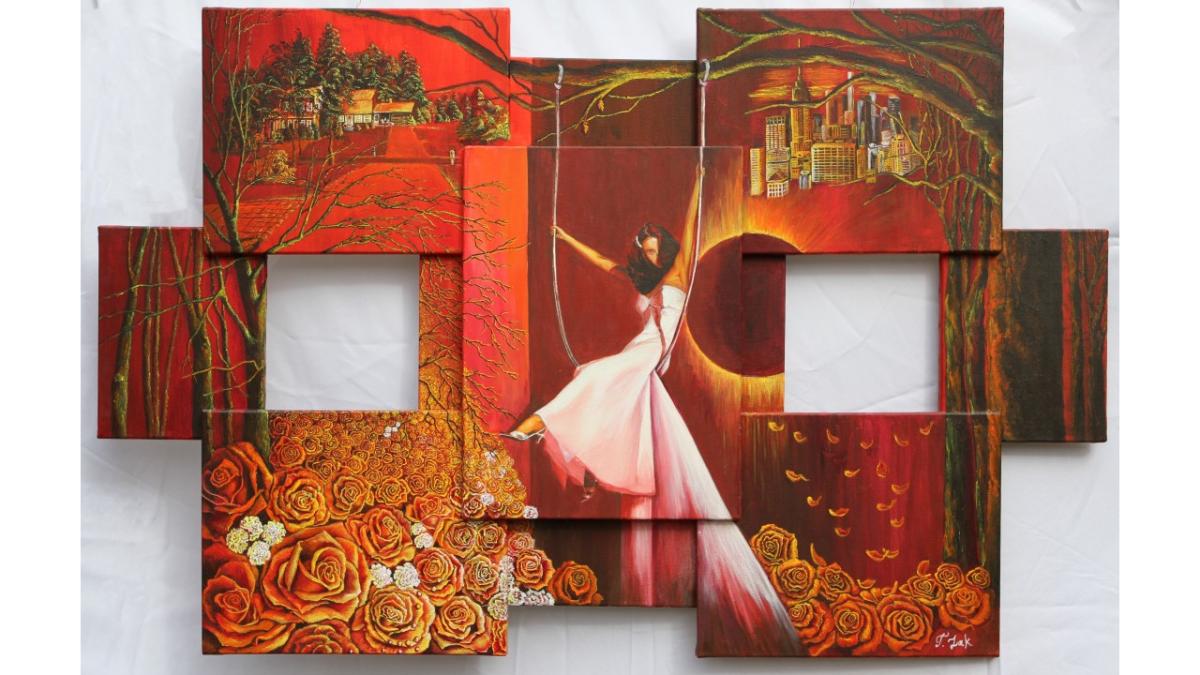
A single large piece, a statement painting, a hand-embellished print like Tatyana Zak's Swing of Life installation, should anchor the room. The center should sit at 57-60 inches from the floor. This creates a natural focal point that your eye gravitates toward when you enter the space.
Multi-Piece Arrangements and Focal Points
One piece should dominate through size, color, or placement, with others supporting it to create visual hierarchy.
Art Hanging Tools and Hardware for Secure Installation
The right hardware is invisible when it works and obvious when it fails. Choosing correctly means your art stays on the wall and your wall stays intact.
Choosing the Right Hardware for Your Wall Type
Drywall anchors distribute weight across wider areas. Plastic anchors work for pieces under 15 pounds; toggle bolts suit heavier pieces.
Rental-Friendly Hanging Methods
Renters can display art in homes without permanent installation using several damage-free methods.
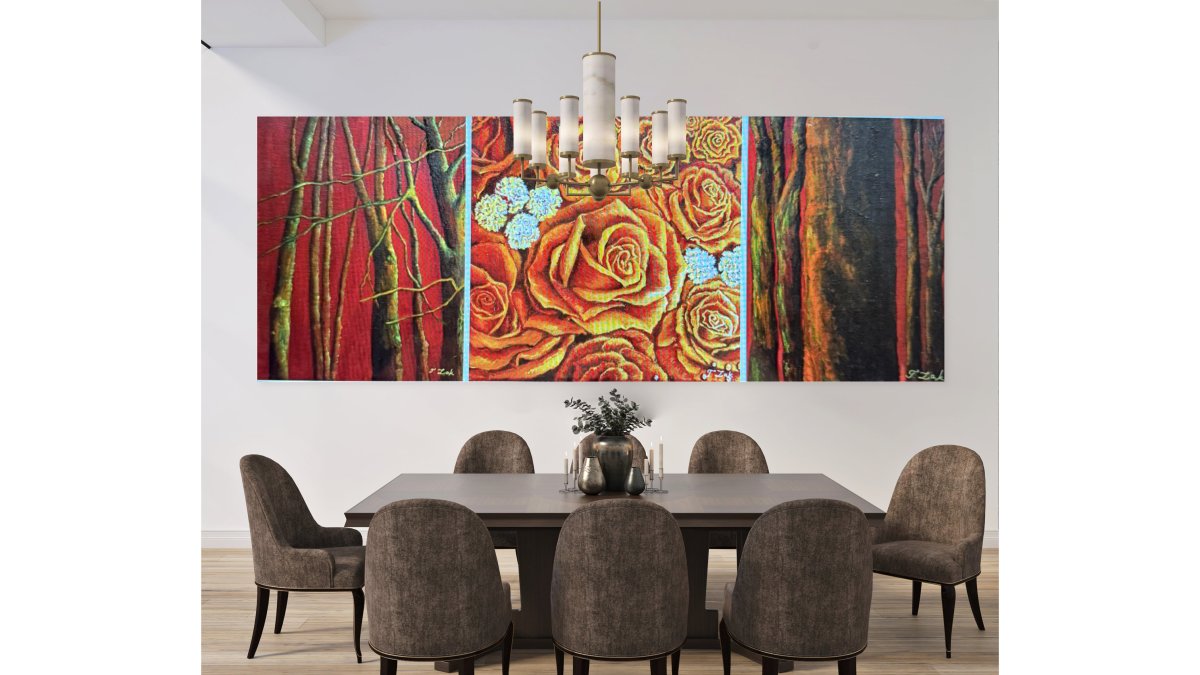
Set of 3 Canvases- Roses and Trees →
Mixing Media, Textures, and Creating Visual Depth
Mix paintings, photography, textiles, and three-dimensional pieces to create visual richness.
Combining Paintings, Photography, and Textiles
Paintings bring color and emotion; photography brings specificity and light; textiles bring texture and dimension.
Matting, Frames, and Hand-Enhanced Details
Matting protects art and creates breathing room. A generous mat enlarges small pieces; minimal mats feel contemporary.
Lighting Your Artwork and Creating Ambiance
Light transforms art. The same piece looks entirely different in morning sunlight versus evening lamplight. Strategic lighting can make your collection feel gallery-quality.
Accent Lighting and Spotlighting Techniques
Picture lights cast light downward, revealing texture and detail on statement pieces and focal points.
Natural Light Considerations
Direct sunlight fades art over time. Position valuable pieces away from direct sun exposure.
Room-by-Room Display Strategies and Curation
How you display art in homes depends entirely on the room's function and the mood you want to create. The same piece might be perfect in a living room but wrong in a bedroom.
Living Rooms and Statement Pieces
Living rooms are where you make bold choices with statement pieces or gallery walls that get an audience.
Bedrooms, Offices, and Intimate Spaces
Bedroom art should feel personal. A single emotionally resonant piece works better than a busy gallery wall.
Hallways and Transitional Areas
Hallway art should be bold and immediate. A striking piece stops people; a series creates a visual journey.
Budget-Conscious Framing and Sourcing Strategies
Smart sourcing and framing let you build an intentional, curated collection on any budget.
Frequently Asked Questions
What is the 57-inch rule for hanging art?
The 57-inch rule is a standard measurement for hanging artwork at eye level. Measure 57 inches from the floor to the center of your artwork, this accounts for average standing eye level. For seating areas, lower the center point to 52-54 inches. This principle applies whether you're displaying a single piece or a gallery wall, ensuring your art feels naturally positioned rather than too high or too low.
How do I create a balanced gallery wall layout?
Start by arranging your frames on the floor to plan your gallery wall layout ideas before hanging anything. Use painter's tape to outline frame positions on your wall, or create paper templates. Maintain consistent spacing (2-3 inches between frames) and consider using both symmetrical grids and asymmetrical salon-style arrangements. Group artwork of varying sizes to create visual interest while keeping the overall composition balanced through negative space and color distribution.
What hanging hardware works best for different wall types?
For drywall, use picture hooks rated for your artwork's weight, typically 25-50 pounds per hook. Plaster walls require special anchors to prevent cracking. Concrete or brick walls need masonry anchors and a drill. For rental properties, adhesive strips and damage-free hanging solutions offer alternatives to nails. Always consider your artwork's weight and your wall material when selecting art hanging tools and hardware to ensure secure, long-lasting installation.
Should I light my artwork, and how?
Accent lighting dramatically enhances artwork by creating depth and highlighting details. Picture lights mounted above frames work well for single pieces, while track lighting or adjustable spotlights suit gallery walls. Position lights at a 30-degree angle to minimize glare. Natural light is beautiful but can fade artwork over time, so balance it with window treatments. Hand-embellished pieces like those from Tatyana Zak benefit particularly from subtle accent lighting that reveals the texture and depth of added acrylic details.
Can I display art in rental homes without damaging walls?
Yes. Use adhesive picture hanging strips, damage-free hooks, or picture rails that mount to walls without permanent installation. Leaning artwork on shelves or ledges offers another rental-friendly option. Art ledges and picture rails are particularly effective for creating gallery wall effects while remaining removable. These methods work well for displaying canvas prints and framed pieces without leaving holes, making them ideal for temporary or rented spaces.
How do I choose the right size art for my wall?
As a general guide, artwork should occupy 50-75% of the wall space above furniture. For a single piece above a sofa, aim for art that's two-thirds the width of the furniture. In larger rooms, oversized pieces create focal points, while smaller artworks work in intimate spaces or as part of a gallery wall. Consider your room's scale and proportion, a small 12x12 canvas suits a bedroom, while a 42x66 installation makes a statement in a living room.
What's the difference between diptych, triptych, and multi-panel installations?
A diptych consists of two panels displayed together, a triptych has three, and multi-panel works can have four or more. These arrangements create rhythm and narrative flow across a wall. The Swing of Life™ collection, for example, offers a four-panel hand-enhanced installation that works as individual pieces or as a cohesive set. Multi-panel works allow flexibility, display them together for impact or separate them across different rooms.
How do I mix different types of artwork without creating visual chaos?
Create unity through consistent framing, matting, or color palettes. Mix media (paintings, photography, textiles, sculpture) by grouping similar pieces or alternating them intentionally. Maintain balance through scale and proportion, don't cluster all large pieces together. Hand-enhanced prints with added acrylic texture work beautifully alongside traditional paintings and photography because the added dimensional details create visual interest without overwhelming the composition.