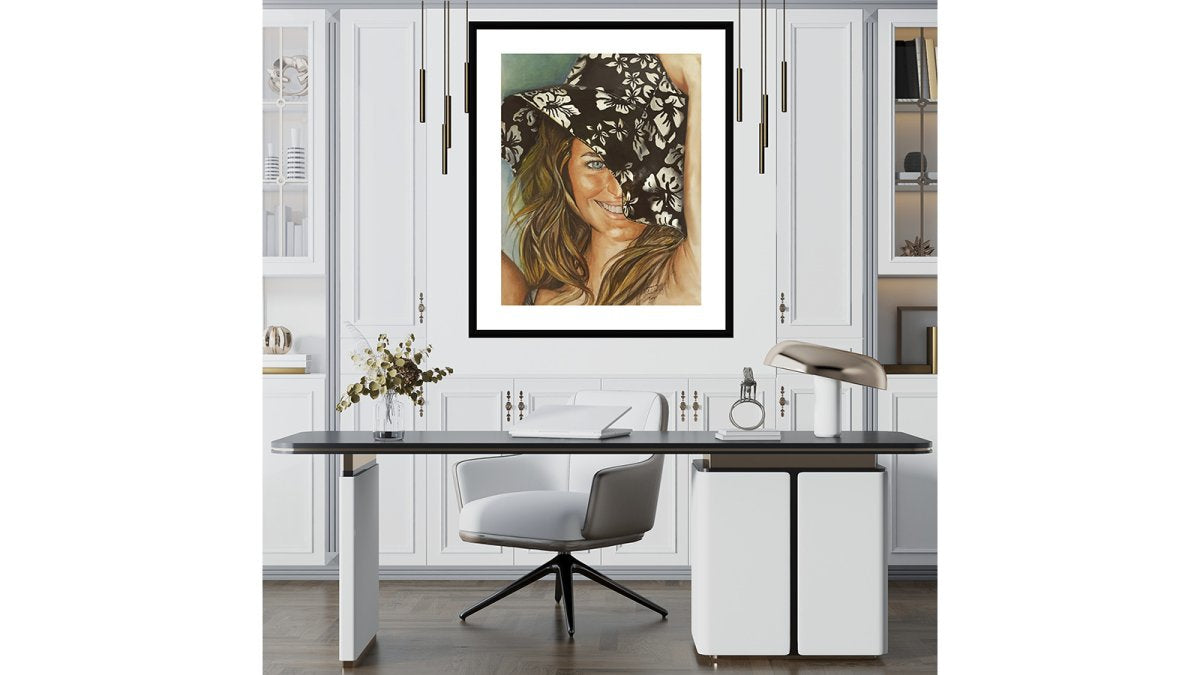
How to Choose the Right Art Print Size for Your Wall
Last Updated: November 1, 2026
Quick Summary
Choose an art print size by measuring your wall and the furniture below it, then picking artwork that fills 60-75% of that width. For example, an 84-inch sofa calls for 50-63 inches of total art width. Always calculate finished dimensions with frame and mat before buying.
- Measure wall width, height, and furniture width before you shop for any print.
- Standard print sizes include 8 x 10, 11 x 14, 16 x 20, 18 x 24, and 24 x 36 inches.
- Hang art so its center sits roughly 57-60 inches from the floor.
- Keep 2-3 inches of consistent spacing between frames on a gallery wall.
- Cut paper templates to finished dimensions and tape them up before buying.
Table of Contents
- Start With Your Wall Measurements
- Use the 60-75% Rule for Art-to-Wall Ratio
- Choosing the Right Art Size Above a Sofa
- Standard Art Print Sizes and Aspect Ratios
- Gallery Wall Layout and Spacing That Looks Intentional
- How High to Hang Wall Art for Balance
- Factor In Frame, Mat, and Finished Dimensions
- Test the Size Before You Buy or Hang
- Frequently Asked Questions
Start With Your Wall Measurements
The right art print size starts with two numbers: your wall's width and the width of the furniture below it. Everything else follows from those measurements. Collectors often fall in love with a piece online, then discover it swallows the room or disappears on a large wall. A tape measure prevents that.
Measure first, shop second. It takes ten minutes and saves a return.
Measuring Wall Width and Height
Run your tape measure along the full width of the empty wall, corner to corner. Then measure from floor to ceiling. Write both numbers down.
Next, note what sits on that wall. A sofa, a bed, a console, or nothing at all. Measure that piece's width too.
For a wall with furniture, you'll work from the furniture width. The American Society of Interior Designers publishes guidance on scale and proportion that supports this furniture-first approach.
Calculating Available Wall Space
Available wall space is the clear area you can actually use, not the whole wall. Subtract obstacles:
- Door swings and light switches
- Windows and their trim
- Thermostats, vents, and outlets
The remaining rectangle is your canvas. A common mistake is measuring the wall but ignoring a swing door that will clip the frame. Check clearance before you commit.
Use the 60-75% Rule for Art-to-Wall Ratio
The most reliable art print size rule: artwork should fill roughly 60-75% of the width of the furniture or wall area below it.
Here's the math. If your sofa is 84 inches wide, multiply by 0.60 and 0.75:
- 84 × 0.60 = 50 inches
- 84 × 0.75 = 63 inches
So your total art width should land between 50 and 63 inches. That's the target zone. A single large print or a group of smaller ones can both hit it.
The 60-75% band is a practical starting point for most walls. Aim for the middle of that range.
Choosing the Right Art Size Above a Sofa
Art size above a sofa should span 60-75% of the sofa's width and hang 6-10 inches above the backrest. That gap connects the art to the furniture instead of letting it float.
For a standard 84-inch sofa, that means 50-63 inches of total art width. Options:
- One large landscape print at 48 × 36 inches
- Two matched portrait prints, each around 24 × 36 inches
- Three smaller prints with 2-3 inches between frames
Keep the bottom edge of the frame within that 6-10 inch window. Too high and the art looks disconnected. Too low and it crowds the people sitting below.
A common mistake is centering art on the wall instead of on the sofa. Center it on the furniture. The wall doesn't care, but the room does.
Standard Art Print Sizes and Aspect Ratios
Standard art print sizes make framing simple and predictable. The most common sizes are 8 × 10, 11 × 14, 16 × 20, 18 × 24, and 24 × 36 inches.
| Print Size | Aspect Ratio | Best For | Orientation |
|---|---|---|---|
| 8 × 10 in | 4:5 | Small walls, shelves, groupings | Portrait or landscape |
| 11 × 14 in | 11:14 | Hallways, paired prints | Portrait or landscape |
| 16 × 20 in | 4:5 | Above a desk or dresser | Portrait or landscape |
| 18 × 24 in | 3:4 | Medium walls, single statements | Portrait or landscape |
| 24 × 36 in | 2:3 | Large walls, above a sofa | Portrait or landscape |
Aspect ratio is the relationship between width and height. A 2:3 image printed at 24 × 36 keeps its original proportions.
Our hand-enhanced collector's editions include the 16" x 20" Early Roses print at $325.00. Select custom sizes may be available upon request.

Matching Print Dimensions to Image Resolution
Bigger prints need more pixels. A file that looks sharp on screen can turn soft at 24 × 36 inches.
The working standard is 300 DPI, or dots per inch, for gallery-quality output. Multiply the print's inches by 300 to find the minimum pixel dimensions:
- 8 × 10 inches needs 2,400 × 3,000 pixels
- 16 × 20 inches needs 4,800 × 6,000 pixels
- 24 × 36 inches needs 7,200 × 10,800 pixels
Below that, detail starts to break down. Ask the seller for the file's pixel dimensions before you buy a large piece.
Gallery Wall Layout and Spacing That Looks Intentional
A gallery wall lives or dies on spacing math. The standard gap between frames is 2-3 inches, and the whole arrangement should still hit that 60-75% width target. But the step most guides skip is calculating the total arrangement dimensions before you buy a single frame. Here is a worked example you can copy.
Early Roses- 16" x 20" Hand-Enhanced Collector's Edition Print →
Worked Example: A Three-Piece Gallery Wall Above an 84-Inch Sofa
Start with the target zone. An 84-inch sofa at 60-75% gives you 50-63 inches of total art width.
Suppose you want three 16 x 20 inch frames in portrait orientation, each with a 2-inch mat and a 1-inch frame.
Total width with 3-inch gaps: 20 + 3 + 20 + 3 + 20 = 66 inches.
This is why you calculate finished dimensions first.
Spacing Rules That Hold Up
- Keep gaps consistent: 2-3 inches between frames. Three inches reads as deliberate; two inches reads as tight but intentional in small spaces.
- Align the outer edges to a clean rectangle. The group should read as one shape when you apply the 60-75% ratio rule.
- Center the group on the furniture, not the wall. The wall doesn't care, but the room does.
Plan on the Floor, Then Transfer
Cut paper templates to the finished dimensions of each frame, including mat and frame. Arrange them on the floor until the spacing looks even, then measure the total width and height of the finished group.
For a deeper look at layout styles, our guide to symmetrical vs. asymmetrical gallery walls walks through both approaches. If your wall space is tight, modern gallery wall ideas for small spaces shows arrangements that fit narrow rooms.
How High to Hang Wall Art for Balance
Hang wall art so its center sits at eye level, roughly 57-60 inches from the floor. This is a common starting point for most rooms.
Adjust for context:
- Above furniture: keep the bottom edge 6-10 inches above the piece
- In a hallway: center on the average viewer's eye line
- Over a bed: measure from the headboard, not the floor
Ceiling height matters too. In rooms with tall ceilings, nudging the art up slightly keeps it from feeling stranded. In low rooms, stay closer to the standard line. When in doubt, go lower. Art hung too high is the most common hanging mistake we see.
Factor In Frame, Mat, and Finished Dimensions
The print size is not the size that hangs on your wall. Finished dimensions include the frame and mat, and they can add several inches on every side.
A 16 × 20 print with a 3-inch mat and a 1-inch frame becomes 24 × 28 inches finished. That changes your ratio math.
- Image size: the printed artwork itself
- Mat: the border between print and frame
- Frame: the outer edge that defines finished size
Always calculate finished dimensions before you buy. A print that fits your target zone bare may overshoot it once framed.
Test the Size Before You Buy or Hang
Test the size on the wall before you spend a dollar. Painter's tape and paper templates show you exactly how a piece will look in the room, but the test is only useful if you check it from the right distance and against the room's vertical proportions. Here is a fuller testing routine that accounts for viewing distance, ceiling height, and finished dimensions.
The Five-Step Template Test
- Cut a paper template to the finished dimensions, frame and mat included, not the bare print size.
- Tape it to the wall at your planned height, centering on the furniture below.
- Step back to your normal viewing distance. For a sofa, that is roughly the width of the seating area plus a few feet. For a hallway, it is the width of the walkway.
- Check it from the doorway and from the sofa. A piece that looks right up close can look lost from across the room.
- Leave it up for a day and see how it feels in different light.
This method costs almost nothing and helps prevent costly mistakes. Watch out: skipping the template stage is how people end up with art that's too small for a large wall.
Factor In Viewing Distance and Ceiling Height
Wall width alone can mislead you. Viewing distance changes the perceived size of a print: a 24 x 36 inch piece viewed from 10 feet reads smaller than the same piece viewed from 4 feet.
Ceiling height matters too. In rooms with 10-foot ceilings, a piece hung at the standard 57-60 inch center line can feel stranded; nudging it up slightly keeps it connected to the room's vertical scale.
A Simple Size Calculator You Can Do on Your Phone
Turn your measurements into a specific recommendation with this sequence:
- Measure furniture width (or wall width for a bare wall).
- Multiply by 0.60 and 0.75 to get your target art width range.
- Add your frame and mat allowance to each candidate print size to get finished width.
- Pick the print size whose finished width lands inside the range.
- Adjust for viewing distance: choose the upper end for far viewing, the lower end for close viewing.
Example: an 84-inch sofa gives a 50-63 inch target. A 24 x 36 print with a 2-inch mat and 1-inch frame finishes at 30 x 42 inches, inside the range as a single statement piece.
Once you've confirmed the size, you're ready to commit. Browse art sets sized for your chosen layout. Explore the Four-Panel Journey in Balance set at $625.00.

Frequently Asked Questions
What is the ideal art print size for a wall?
There is no single ideal size, but the art-to-wall ratio gives you a reliable starting point. Aim for artwork that fills roughly 60-75% of the available wall width, especially above furniture. For a 90-inch sofa on a 10-foot wall, that means a piece or arrangement around 54 to 67 inches wide. Measure your wall width and height first, then let the ratio and your furniture width narrow the options.
How wide should art be above a sofa?
Art above a sofa should span about two-thirds of the sofa's width. For a standard 84-inch sofa, that means artwork or a gallery arrangement roughly 56 to 63 inches wide. Keep the bottom edge 6 to 10 inches above the sofa back so the art feels connected to the furniture rather than floating. A single large canvas or a tight group of smaller prints both work if they hit that width.
What are the standard art print sizes I should look for?
Common standard art print sizes include 8 × 10, 11 × 14, 16 × 20, 18 × 24, and 24 × 36 inches. These follow familiar aspect ratios, so frames and mats are easy to find. Match the print dimensions to your wall and furniture first, then check that the image resolution supports the size at 300 DPI. A 16 × 20 canvas, for example, suits a narrow wall or a small gallery grouping.
How high should I hang wall art?
Hang art so its center sits at eye level, typically 57 to 60 inches from the floor. Above furniture, measure from the furniture's top edge instead: keep the bottom of the frame 6 to 10 inches above a sofa or console. In rooms with high ceilings, nudge the art slightly higher to keep it visually connected to the seating area rather than stranded near the ceiling.
Sizing art well comes down to measurement, ratio, and a little patience with tape and paper. Tatyana Zak makes that final step easier with hand-embellished collector's editions, each one individually enhanced with acrylic paint by the artist, signed and numbered, and shipped with a certificate of authenticity. No two pieces are identical. Get started with Tatyana Zak and find a piece that fits your wall and your story.