Eyes on Walls vs Ashvin Harrison: Which Art Fits?
Table of Contents
- Eyes on Walls vs Ashvin Harrison: Two Paths to Contemporary Art
- Style and Medium Compared: Hyper-Real Figures vs Abstract Splashes
- Limited Edition Prints vs Mass Produced: What the Edition Size Really Means
- Benefits of Hand-Embellished Art for Collectors and Interiors
- How to Choose Wall Art for Home: A Practical Selection Framework
- Investment Value, Collector Market, and Where Each Artist Fits
- Conclusion
- Frequently Asked Questions
Last Updated: September 17, 2026
Eyes on Walls vs Ashvin Harrison: Two Paths to Contemporary Art
The Eyes on Walls vs Ashvin Harrison comparison comes down to one question: do you want curated access to many artists, or a single artist's hand on every surface? Eyes on Walls is a curated online gallery offering prints and canvas reproductions across a broad roster of contemporary artists, while Ashvin Harrison is a self-taught Australian painter known for hyper-real charcoal figures set against abstract splashes of acrylic. At Tatyana Zak, we work in a third lane: hand-embellished limited editions where the artist paints directly onto each canvas.

What Eyes on Walls Offers Collectors
Eyes on Walls functions as a marketplace-style print house. The appeal is breadth: browse dozens of artists, filter by subject or palette, and order a canvas or framed print ready to hang, real convenience for a rental or short-term space.
The trade-off is that you are buying a reproduction, not a piece the artist touched. Editions are typically open or very large, so your print is one of an indefinite run: fine for decoration, weaker for collectors who care about scarcity.
Ashvin Harrison's Charcoal and Acrylic Approach
Ashvin Harrison's work is instantly recognizable: a hyper-real figure, often a dancer or a face mid-expression, rendered in charcoal powder and disrupted by abstract splashes of color. The contrast between tight realism and loose gesture is the point.
Harrison is largely self-taught, and his studio practice leans into volume. Originals sell through his own channels, and reproductions extend each composition's reach. If you want a single artist's unmistakable signature across a whole wall, that consistency is the draw.
Style and Medium Compared: Hyper-Real Figures vs Abstract Splashes
The two catalogs diverge most sharply on medium and intent. Eyes on Walls distributes giclée and canvas prints across many styles, so the "look" depends on which artist you pick. Harrison's look is fixed: charcoal powder for the figure, acrylic for the abstract energy around it.
| Dimension | Eyes on Walls | Ashvin Harrison | Tatyana Zak |
|---|---|---|---|
| Primary medium | Giclée and canvas prints | Charcoal powder, acrylic | Acrylic on canvas, hand-embellished prints |
| Artist involvement | None (reproduction) | Original plus reproductions | Hand-painted on every edition |
| Edition model | Mostly open or large runs | Reproductions, varied runs | Limited, signed and numbered |
| Best for | Fast, varied wall coverage | Collectors of one signature style | Buyers wanting near-original presence |
For visual contrast and a monochrome-to-color range on one wall, Harrison's charcoal work delivers it in a single voice. For mixing styles, the marketplace model wins on variety.
Limited Edition Prints vs Mass Produced: What the Edition Size Really Means
Edition size is the most misunderstood number in art buying, and the sharpest dividing line between the two catalogs here. A limited edition print is a reproduction released in a fixed, numbered quantity, after which the plate or file is retired. Mass produced prints have no cap, so scarcity never enters the equation.
- An edition of 35 means 35 people own that image at that size. Resale value holds because supply is fixed.
- An open edition means the publisher can reprint indefinitely. Resale value is effectively zero.
- A hand-embellished edition sits between the two: the base is a print, but each copy carries unique brushwork, so no two are identical.
Now apply that framework to the two entities in this comparison.
Eyes on Walls operates as a print-on-demand marketplace. When you order from a multi-artist catalog, the file is reproduced to fill your order: no fixed plate, no numbered run, no retirement date. That model makes the breadth possible, dozens of artists, dozens of sizes, fast turnaround, but your print is one of an indefinite quantity, and the publisher can reprint the same image next year in a new size or substrate. For a rental, a staging job, or a first apartment, that is a rational trade. For a buyer who wants the image to hold value, it is a dead end.
Ashvin Harrison's reproductions behave differently in one respect and identically in another. His originals are one of one, a single charcoal-and-acrylic panel that cannot be reprinted. His reproductions, however, typically release through print-on-demand channels too, so the same open-run logic applies. The original is scarce; the reproduction is not.
Swing of Life™ - Hand-Embellished →
Benefits of Hand-Embellished Art for Collectors and Interiors
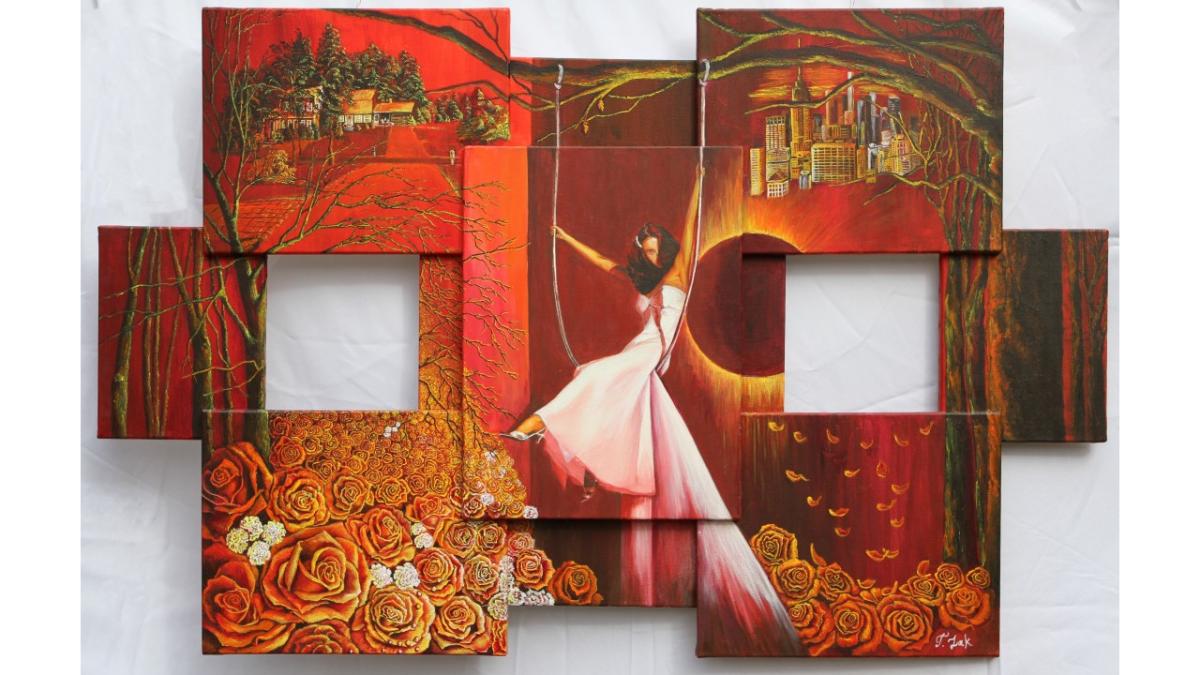
Hand-embellished art solves a specific problem: it gives you the presence of an original at a fraction of the cost, because the artist adds acrylic brushwork over a printed canvas. Texture and depth change under different lighting, brushstrokes catch a lamp at an angle and disappear in daylight.
How to Choose Wall Art for Home: A Practical Selection Framework
Choosing wall art for home starts with three constraints, not taste: the wall, the light, and the budget. Answer those first and the shortlist builds itself.
Work through this checklist before you commit:
- Measure the wall. A canvas should occupy roughly two-thirds to three-quarters of the furniture width below it. A 42" x 66" installation needs a substantial wall, not a hallway.
- Check the light. North-facing rooms flatten warm tones. A piece built on reds and golds, like Bride on the Swing, reads differently in cool light than in afternoon sun.
- Set the edition rule. Decide now whether you care about scarcity. If you do, filter out open editions immediately.
- Match the room's job. A wellness studio or therapy office benefits from work that rewards slow looking. A busy entryway needs a bolder silhouette.
- Confirm the logistics. Verify hanging hardware, depth, and shipping before purchase. A 2.5" deep canvas needs different mounting than a flat print.
Investment Value, Collector Market, and Where Each Artist Fits
Where each fits, in one line each: Eyes on Walls fits the buyer who wants variety and speed and does not care about resale. Ashvin Harrison fits the collector who wants a single signature and will pay for an original. Hand-embellished limited editions fit the buyer who wants near-original presence, documented scarcity, and a price that does not require a private inquiry.
Conclusion
The hard part of this comparison is not picking a winner; it is admitting what you actually want. If you want variety and speed, a marketplace model serves you. If you want one artist's unmistakable signature, a single-painter catalog delivers it.
Frequently Asked Questions
Who is Ashvin Harrison and what is his artistic style?
Ashvin Harrison is a self-taught contemporary artist known for hyper-real figures and abstract splashes built from charcoal powder, acrylic, and mixed media. His work often pairs a detailed portrait or animal figure with loose, expressive color fields, creating strong visual contrast and a sense of visual motion. The style sits between fine art and contemporary art, and the monochrome underpainting gives each piece its texture and depth. Collectors drawn to emotional, high-contrast work often find his layering technique appealing, and his pieces are available as original paintings and canvas prints.
What is the difference between mass-produced art and limited edition prints?
Mass-produced art is printed in unlimited runs, so the same image stays available indefinitely and resale value is minimal. Limited edition prints are capped at a set number, signed and numbered by the artist, and often include a Certificate of Authenticity. When you compare limited edition prints vs mass produced, the difference comes down to scarcity, artist involvement, and long-term collector value. A hand-embellished limited edition goes one step further: the artist adds acrylic paint to each piece, so no two are identical and each carries original brushwork.
How does hand-embellishment change the value of an art print?
Hand-embellishment adds original brushwork to a printed base, which moves the piece closer to an original painting in character and presence. Because the artist paints on each print individually, no two collector editions are exactly alike, and the edition is usually small. That combination of scarcity and direct artist involvement supports stronger long-term value than a standard reproduction. It also gives buyers the texture and depth of an original without the price of one. Pieces such as the Swing of Life hand-embellished collector edition are signed, numbered, and come with a Certificate of Authenticity.
What should you look for when buying canvas prints for your home?
Start with the edition size, artist signature, and Certificate of Authenticity, since these separate a collector piece from a poster. Check the canvas type and depth, the mounting hardware, and whether the piece is hand-embellished or a flat reproduction. Then match the scale to your wall: a 42" x 66" installation anchors a large room, while a 24" x 24" canvas suits a hallway or office. Finally, confirm the return policy and shipping terms. When you choose wall art for home, buy the piece you can live with daily, not just the one that photographs well.
How do you distinguish between high-quality reproductions and original art?
Original art is created directly by the artist, usually one of a kind, and comes with provenance documentation. High-quality reproductions are printed from a master file, then may be hand-embellished with acrylic to add texture and depth. The clearest signals are the edition size, the signature, the numbering, and the Certificate of Authenticity. A limited edition of 35 hand-embellished canvases sits between the two: it is not a one-off original, but it carries the artist's hand and a fixed release, which is why collectors treat it differently from an open-run print.