Ashley Salvatori Alternative: Contemporary Art Guide
Table of Contents
- Why Collectors Look for an Ashley Salvatori Alternative in Contemporary Art
- Limited Edition Prints vs Mass-Produced Prints: What the Edition Number Tells You
- Hand-Embellished Art Prints: Where Acrylic Brushwork Changes the Piece
- Framed vs. Unframed Art Prints: Display, Protection, and Cost
- Alternatives by Budget: Contemporary Art From $495 to $49,000
- Original Art vs Reproductions: What You Are Actually Paying For
- Choosing an Alternative: A Side-by-Side Comparison Framework
- Conclusion: Matching the Piece to the Room and the Reason
- Frequently Asked Questions
Last Updated: October 14, 2026
Why Collectors Look for an Ashley Salvatori Alternative in Contemporary Art
Collectors searching for an Ashley Salvatori alternative for contemporary art usually aren't dissatisfied with her work. They've simply outgrown what a standard print run can offer.
The gap most buyers notice first is physical. A mass-produced print looks identical to the thousand next to it. A hand-embellished piece does not.
Below, we break down the formats, the price tiers, and the questions worth asking before you buy.
Limited Edition Prints vs Mass-Produced Prints: What the Edition Number Tells You
The comparison between limited edition prints vs mass-produced prints comes down to one number: the edition size. A limited edition is capped, signed, and numbered. A mass-produced print has no cap at all.
That cap changes three things. Rarity, resale potential, and how the piece feels on your wall. An edition of 35 means 35 people own that work. An open edition means thousands might.
How to Verify an Edition Is Genuinely Limited
A genuine limited edition should give you four things in writing:
- A stated edition size, printed or documented
- A signature from the artist
- A number matching the total, such as 12/35
If a seller can't tell you the edition size, treat the print as open. The U.S. Copyright Office guidance on visual arts registration explains how artists document authorship, which is the paper trail behind a real edition.
Hand-Embellished Art Prints: Where Acrylic Brushwork Changes the Piece
Hand-embellished art prints are printed works that the artist then paints over by hand, usually with acrylic. The print provides the structure. The brushwork adds texture, depth, and variation that a printer cannot produce.
This is the middle ground between a reproduction and an original. You get the composition of the original at a fraction of the cost, plus genuine handwork on every surface.
What Hand Embellishment Actually Looks Like Up Close
Stand a few feet back and a hand-embellished print reads like the original. Step closer and you see raised paint, uneven edges, and small color shifts where the brush moved.
That unevenness is the point. It's also why no two pieces in an edition match. Tatyana Zak's hand-embellished collector editions work this way: each canvas is painted over individually with acrylic, so every piece carries its own surface.
Framed vs. Unframed Art Prints: Display, Protection, and Cost
The framed vs. unframed art prints decision is really about who controls the finish. Framed arrives ready to hang.
Cost is the trade-off. Framing adds expense, but it also protects the surface and saves you a trip to a framer.
| Option | Upfront Cost | Protection | Best For |
|---|---|---|---|
| Unframed | Lower | Minimal until framed | Buyers with a specific frame in mind |
| Framed | Higher | Immediate | Gifts and quick installation |
| Gallery-wrapped canvas | Mid | Built-in, no frame needed | Contemporary interiors |
Gallery-wrapped canvas sits between the two. The canvas wraps around a solid wood frame, so it hangs without a display frame.
Alternatives by Budget: Contemporary Art From $495 to $49,000
Contemporary art pricing spans a wide range, and the tiers below reflect what different budgets actually get you. The lower end buys a hand-embellished collector edition. The top end buys the original installation itself. Organizing alternatives by budget is the fastest way to narrow the field, because price tier usually maps to format, edition size, and how much handwork is on the surface.
Here's how the options stack up side by side:
| Piece | Format | Size | Edition Size | Price |
|---|---|---|---|---|
| Bride on the Swing | Hand-enhanced canvas print | 24" x 18" | Limited | $495 |
| Night Blues of the Suburbs | Hand-enhanced canvas print | 24" x 24" | Limited | $595 |
| A Four-Panel Journey in Balance | Hand-enhanced print set | 16" x 16" per panel | Limited | $625 |
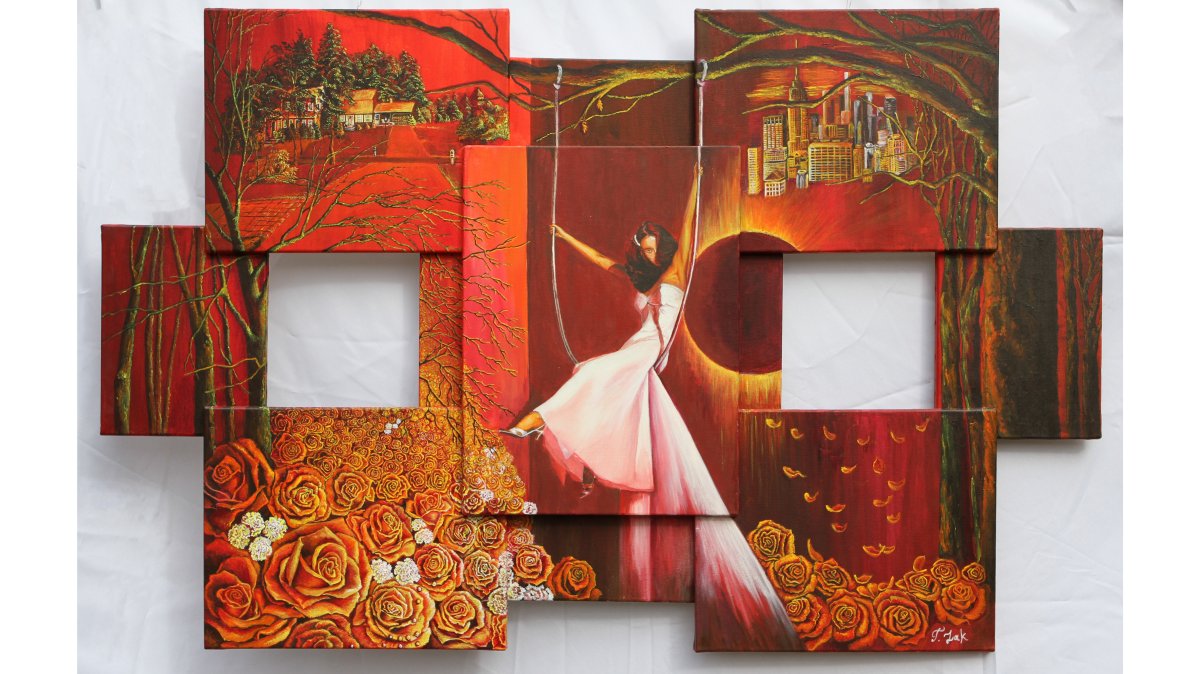
| Swing of Life Collector Edition | Hand-embellished canvas installation | 42" x 66" | 35 | $999 |
| Swing of Life Original | Original acrylic on canvas | 42" x 66" | 1 of 1 | $49,000 |
Under $1,000: Collector Editions and Panel Sets
Three works sit under $1,000, and each suits a different room. Bride on the Swing at $495 brings warm reds and golds into a smaller space. Night Blues of the Suburbs at $595 leans cool and quiet, good for a bedroom or reading corner.


For a larger wall, A Four-Panel Journey in Balance at $625 gives you four 16" x 16" panels that hang as a set or separately. At the top of this tier, the Swing of Life Collector Edition at $999 is an eight-canvas installation in an edition of 35.

What you receive at this tier: a hand-embellished canvas print, signed and numbered, with a certificate of authenticity, arriving gallery-wrapped with mounting hardware. You are not buying the original composition.
$1,000 to $10,000: What This Tier Typically Buys
This is the range where buyers usually move from embellished prints into small originals, studies, or multi-panel works on paper. A common pattern in the contemporary market is that a single original on canvas at this tier is smaller than a collector edition at the same price, because you are paying for uniqueness rather than surface area. If wall coverage matters more than one-of-a-kind status, a large embellished edition usually wins.
Swing of Life™- 42" x 66" Original Acrylic on Canvas Painting Installation →
Private Acquisition: The Original Installation
The original Swing of Life is available by private studio inquiry at $49,000. It's a 42" x 66" acrylic on canvas installation, eight integrated canvases, signed with a certificate of authenticity and provenance documentation.
Acquisition happens directly with the studio. Payment arrangements, insured shipping, and installation consultation are handled individually. This tier is for collectors who want the work itself, not a version of it.
What Changes as the Price Rises
Three things shift as you move up the tiers:
- Uniqueness. A collector edition exists in a capped run. The original exists once.
- Handwork. Embellished prints carry partial handwork added after printing. Originals carry the full texture of the paint.
- Documentation. Both should include a certificate of authenticity. Originals also carry provenance, the record of ownership.
The FTC guidance on advertising claims for art and collectibles is worth reading if a seller's claims about authenticity or edition size feel vague.
Original Art vs Reproductions: What You Are Actually Paying For
Original art vs reproductions is not a quality contest. It's a question of what you're buying. With an original, you're buying the object the artist made. With a reproduction, you're buying an image of it.
Three things change the price:
- Uniqueness. An original exists once. A hand-embellished edition exists 35 times, each one different.
- Surface. Originals carry the full texture of the paint. Hand-embellished prints carry partial texture added after printing.
- Documentation. Both should come with a certificate of authenticity. Originals also carry provenance, the record of ownership.
The FTC guidance on advertising claims for art and collectibles is worth reading if a seller's claims about authenticity feel vague.
Choosing an Alternative: A Side-by-Side Comparison Framework
Most buyers comparing contemporary art alternatives are weighing pieces that look nothing alike, which makes a generic scoring rubric useless. The framework below compares options on the criteria that actually change what you receive: style, subject matter, medium, customization, and price. Use it to compare any two pieces, whether they come from the same studio or different ones.
The Five Comparison Criteria
| Criterion | What to Compare | Why It Changes the Purchase |
|---|---|---|
| Style | Contemporary, impressionist, abstract, or representational | Determines whether the piece fits the room's existing aesthetic |
| Subject matter | Floral, botanical, coastal, landscape, or figurative | Drives placement, a coastal scene reads differently in a bedroom than a hallway |
| Medium | Original acrylic, hand-embellished canvas print, giclée on archival paper, or open-edition print | Sets the ceiling on texture, longevity, and resale |
| Customization | Edition size, handwork level, framing, panel configuration | Separates a decorative purchase from a collector purchase |
| Price | Upfront cost plus framing, shipping, and installation | Reveals the true cost of ownership, not just the sticker |
How to Apply It
Score each piece you're considering from 1 to 5 on each criterion, then weight the criteria to match your reason for buying.
- Buying to decorate a specific wall: weight style, subject matter, and price most heavily. A hand-embellished canvas print at $495 to $999 will usually beat a smaller original on wall coverage per dollar.
- Buying to build a collection: weight medium, customization, and documentation most heavily. Edition size and handwork are the two criteria that separate a collector purchase from a decorative one.
- Buying as a gift: weight price and customization. Framed or gallery-wrapped pieces arrive ready to hang, which removes a step for the recipient.
A Worked Comparison
Take two pieces at similar price points: a 24" x 24" hand-enhanced canvas print at $595 and a 24" x 18" hand-enhanced canvas print at $495. On style and subject matter, they may score identically.
Now compare either of those against the original installation at $49,000. The original wins on medium, customization, and documentation by a wide margin. It loses on price.
Questions to Ask Before You Commit
- What is the exact edition size, and is it documented in writing?
- How much of the surface is painted by hand versus printed?
- Does the piece arrive framed, gallery-wrapped, or unframed?
The U.S. Copyright Office guidance on visual arts registration explains how artists document authorship, which is the paper trail behind a real edition.
Conclusion: Matching the Piece to the Room and the Reason
The right alternative depends on why you're buying. If you want the original, the Swing of Life installation is available by private inquiry.
At Tatyana Zak, every piece is signed, numbered, and shipped with a certificate of authenticity. No two are identical.
Get started with Tatyana Zak and find the piece that fits your space and your reason for buying it.
Frequently Asked Questions
What are some alternatives to Ashley Salvatori for contemporary art?
Buyers seeking a comparable alternative can look at artist-direct collections that combine limited editions with hand finishing. Tatyana Zak's Swing of Life Collection includes hand-embellished limited edition prints from $495 to $999, a four-panel set at $625, and an original acrylic on canvas installation available by private inquiry at $49,000. Each collector edition is signed, numbered, and shipped with a Certificate of Authenticity, which gives you documentation an open-edition marketplace listing usually does not.
How do Ashley Salvatori prints compare with hand-enhanced limited edition prints?
The main difference is what happens after printing. A standard print is reproduced and shipped as-is, so every copy matches. A hand-embellished art print gets additional acrylic brushwork applied by the artist, so no two pieces are identical. Tatyana Zak's collector editions are limited to small release sizes, individually signed and numbered, and include a Certificate of Authenticity. If you want a piece that carries visible brush texture and a defined edition count, the hand-enhanced route gives you more to hold onto.
What is the difference between a limited edition print and a mass-produced print?
A limited edition print has a fixed, stated run size. Once that number is reached, no more are produced. Tatyana Zak's Swing of Life hand-embellished collector edition, for example, is capped at 35 pieces. A mass-produced print has no cap and can be reprinted indefinitely, so resale value and rarity stay flat. When comparing limited edition prints vs mass-produced prints, check three things: the stated edition size, whether the piece is numbered, and whether documentation like a Certificate of Authenticity is included.
Are hand-embellished prints considered original art?
They sit between reproduction and original. The base image is printed, but the artist adds acrylic paint by hand, which makes each piece unique. Tatyana Zak describes this process as bridging the space between reproduction and original artwork. A true original, such as the 42" x 66" Swing of Life acrylic on canvas installation at $49,000, is painted entirely by the artist. A hand-embellished edition at $999 gives you original brushwork and a signed, numbered edition at a lower entry point.
Is a framed or unframed art print better for a home?
It depends on the format. Gallery-wrapped canvases like the 24" x 24" Night Blues of the Suburbs at $595 and the 16" x 16" four-panel set at $625 arrive ready to hang with mounting hardware included, so no frame is needed. Framed vs. unframed art prints comes down to protection and style: a frame protects paper-based work and adds a finished look, while unframed canvas keeps the piece lighter and easier to move between rooms. In homes with kids and pets, a stretched canvas on a wall is the lower-maintenance choice.