Article: Why Small Steps Still Count When Life Feels Overwhelming
Why Small Steps Still Count When Life Feels Overwhelming
There are times in life when even the smallest task can feel difficult.
A simple phone call can feel like too much. One unfinished project can become a source of guilt. A goal that once felt exciting can begin to feel impossibly far away. When we are tired, stressed, uncertain, or carrying responsibilities in many different areas of life, it is easy to believe that small progress does not matter.
We may tell ourselves that we should be doing more.
We may compare our pace to someone else's.
We may look at how far we still have to go and forget how much strength it took to reach this point.
But small steps do count.
They count because progress is not always dramatic. Sometimes progress is quiet. Sometimes it is simply choosing not to give up. Sometimes it is doing one thing today that makes tomorrow slightly easier.
A small step may not change everything at once, but it can change the direction in which we are moving.
We Often Expect Progress to Look Bigger Than It Is
Many of us have been taught to recognize only visible achievement.
We celebrate the finished project, the successful launch, the completed painting, the new job, the published book, or the important milestone. We notice the result because it is easy to see.
What we often do not see are the many small decisions that made the result possible.
A completed painting may begin with one sketch.
A book may begin with one paragraph.
A new business may begin with one website page.
A healthier routine may begin with one short walk.
A difficult conversation may begin with one honest sentence.
A meaningful change rarely appears all at once. It grows through repeated actions, adjustments, mistakes, pauses, and new beginnings.
When we only value the final result, we can begin to believe that the steps leading to it are insignificant.
They are not.
The small steps are the work.
What a Small Step Can Look Like
A small step does not need to impress anyone.
It may look ordinary from the outside.
It may be:
- writing down one idea,
- answering one email,
- organizing one corner of a room,
- making one appointment,
- preparing one image for a website,
- reading one page,
- taking ten quiet minutes to think,
- asking for help,
- resting before exhaustion becomes worse,
- or deciding to try again tomorrow.
Small steps can be practical, emotional, creative, or personal.
They do not all have to move us forward in the same way.
Sometimes a small step helps us create.
Sometimes it helps us recover.
Sometimes it helps us make a decision.
Sometimes it simply helps us remain steady during a difficult season.
The value of the step is not determined by how impressive it looks. Its value comes from what it makes possible next.
Progress Is Not Always Visible
Some of the most meaningful progress happens internally.
A person may appear to be standing still while learning how to accept a new reality.
Someone may seem unproductive while recovering from illness or emotional exhaustion.
An artist may not finish a painting for months, yet may be quietly developing the idea, meaning, and direction of the work.
A person may need time before they are ready to make the next decision.
This does not always look like progress, but it can be.
We are often moving internally before anything changes externally.
We may be developing courage.
We may be understanding what we truly want.
We may be learning what no longer works.
We may be rebuilding trust in ourselves.
Those changes are difficult to measure, but they matter.
Not every season is a season of visible achievement. Some seasons are for preparation. Some are for healing. Some are for rebuilding. Some are for simply getting through the day with as much care as possible.
The Pressure to Do Everything at Once
Modern life constantly encourages us to move faster.
We see other people's finished results online without seeing the years of effort behind them. We see announcements, achievements, launches, exhibitions, travels, promotions, and celebrations.
It can create the impression that everyone else is moving quickly while we are falling behind.
But comparison removes context.
We do not know what resources, time, support, health, or circumstances another person has. We also do not know what they may be struggling with privately.
Our lives are not identical, so our pace cannot be identical either.
There is no universal schedule for becoming who we are trying to become.
A slower pace is not automatically a failure.
It may simply be the pace your life currently requires.
Creating While Life Is Already Full
I understand what it feels like to have meaningful ideas and limited time to develop them.
Like many people, I have responsibilities that require my energy and attention. Creative work often has to exist beside a full workday, family responsibilities, health concerns, and the practical demands of everyday life.
There are evenings when I would like to accomplish much more than I realistically can.
At times, this can be frustrating. It can feel as though the vision is moving faster than the available time.
But I have learned that a project does not disappear simply because it must move slowly.
It can remain alive through small, consistent actions.
One paragraph written after work still belongs to the book.
One photograph prepared for the website still supports the business.
One brushstroke still belongs to the painting.
One idea saved in a notebook may later become an exhibition, a podcast episode, a new artwork, or a meaningful conversation.
Small actions protect the larger dream.
What Swing of Life Taught Me About Movement
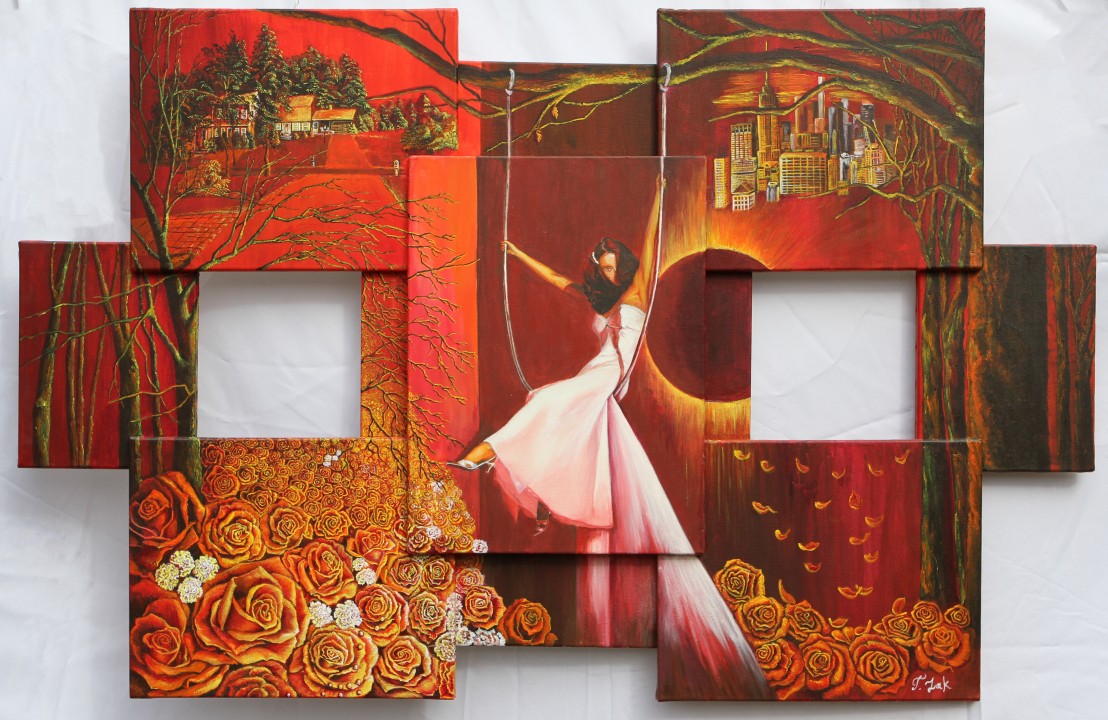
The idea of small steps is deeply connected to my painting Swing of Life.
A swing does not remain in one position.
It moves forward and backward.
Sometimes it rises.
Sometimes it slows.
Sometimes it appears to return to where it began.
But it is still moving.
That rhythm reminds me of the way life often works.
We may have periods of confidence followed by uncertainty. We may make progress and then need to pause. We may revisit an old fear, rethink a decision, or adjust our direction.
From the outside, this movement may appear inconsistent.
But movement does not need to be perfectly straight to be meaningful.
Life is often shaped by cycles rather than direct lines.
We move, pause, reflect, recover, and move again.
The important question is not whether every day looks productive.
The more useful question is whether we are still connected to what matters.
Small Steps During Difficult Times
When life feels overwhelming, large goals can create additional pressure.
Instead of motivating us, they may remind us of everything we have not yet done.
During those times, it can help to reduce the goal until it becomes possible.
Instead of asking:
“How can I finish everything?”
Ask:
“What is one thing I can complete today?”
Instead of asking:
“How can I solve the entire problem?”
Ask:
“What is the next decision?”
Instead of asking:
“How can I completely change my life?”
Ask:
“What would make today slightly more manageable?”
This does not mean abandoning ambition.
It means creating a path that your current energy can support.
There is strength in being realistic.
There is also strength in choosing a step small enough that you can actually take it.
Rest Can Also Be a Step
We sometimes think progress must always involve action.
But rest can also be part of progress.
Rest allows the body and mind to recover. It can create clarity. It can prevent exhaustion from becoming deeper. It can help us return to our responsibilities with greater focus.
There is an important difference between giving up and pausing.
Giving up says, “This no longer matters.”
Pausing says, “This matters enough for me to protect the energy I need to continue.”
Rest is not always the opposite of progress.
Sometimes it is what makes progress possible.
How to Make Small Steps Work
Small steps are most powerful when they are specific.
“Work on my business” is too broad.
“Write the opening paragraph for Monday's blog” is specific.
“Improve my website” is too broad.
“Add one internal link and one email signup link to the new article” is specific.
“Promote my artwork” is too broad.
“Post one close-up image with a short story about its meaning” is specific.
A clear step reduces the mental effort required to begin.
It also creates a visible finish line.
When the task is complete, you can recognize that progress happened.
That recognition matters because confidence grows when we repeatedly prove to ourselves that we can follow through.
One Small Step Can Create Another
Progress often creates momentum.
One completed task makes the next one feel more possible.
One conversation leads to another.
One published article gives you material for an Instagram post, a Pinterest Pin, an email, a short video, and a future podcast topic.
One small piece of work can support several larger goals.
This is especially important when time is limited.
The goal is not always to create more.
Sometimes the goal is to allow one meaningful action to work harder.
A single thoughtful article can educate a reader, strengthen your website, build trust, introduce your artwork, and help someone discover your story.
That is not a small result.
When You Feel Behind
Feeling behind can create shame and discouragement.
But “behind” often depends on an imagined schedule.
Behind compared with whom?
Behind according to what deadline?
Behind in a life with what circumstances?
Sometimes deadlines are real and important. But other times, we are measuring ourselves against an expectation that does not reflect our actual lives.
You are allowed to revise the timeline.
You are allowed to change the method.
You are allowed to reduce the workload.
You are allowed to continue differently than you first imagined.
A delayed dream is not automatically a lost dream.
A slower process can still lead somewhere meaningful.
Small Steps Build Trust in Yourself
Every time you complete one realistic step, you build evidence that you can depend on yourself.
That trust is especially valuable after disappointment, illness, exhaustion, or a period when life felt out of control.
You may not be able to control every outcome.
You may not be able to predict how quickly the result will come.
But you can choose the next action.
You can decide to send the message.
You can prepare the image.
You can write the paragraph.
You can make the appointment.
You can rest and begin again.
These choices may seem small, but they strengthen the relationship you have with yourself.
They say:
“I am still here.”
“This still matters.”
“I am not finished.”
A Gentle Way Forward
There will always be days when we can do more and days when we can do less.
The goal is not to perform at the same level every day.
The goal is to remain connected to the direction that matters to us.
Some days, the step will be visible.
Other days, the step may simply be choosing patience.
Both can be valuable.
The smallest steps do not need to prove anything to anyone else.
They only need to help you continue.
A Final Thought
When life feels overwhelming, we often believe we need a dramatic solution.
Sometimes we do.
But often, what we need first is a smaller beginning.
One honest decision.
One manageable action.
One moment of rest.
One willingness to continue.
Small steps matter because they keep possibility alive.
They remind us that progress does not have to be perfect to be real.
They help us move through uncertainty without demanding that we already know the entire path.
And sometimes, the smallest step becomes the one that changes everything.
Continue the Journey
If this reflection spoke to you, I invite you to read A Gentle Guide to Art and Escape Without Leaving Your Life, where I share more about creativity, reflection, and finding emotional space during demanding seasons.
You can also explore The Meaning of Swing of Life to learn how movement, uncertainty, resilience, and hope became part of the painting's story.
Learn more about my journey in Why I Started Tatyana Zak: Creating Meaningful Art, and visit the Swing of Life collection to discover the artwork connected to this larger project.
Join my email community for new articles, artwork, studio updates, book news, podcast announcements, Kickstarter developments, and future exhibition information.
Warmly,
Tatyana Zak